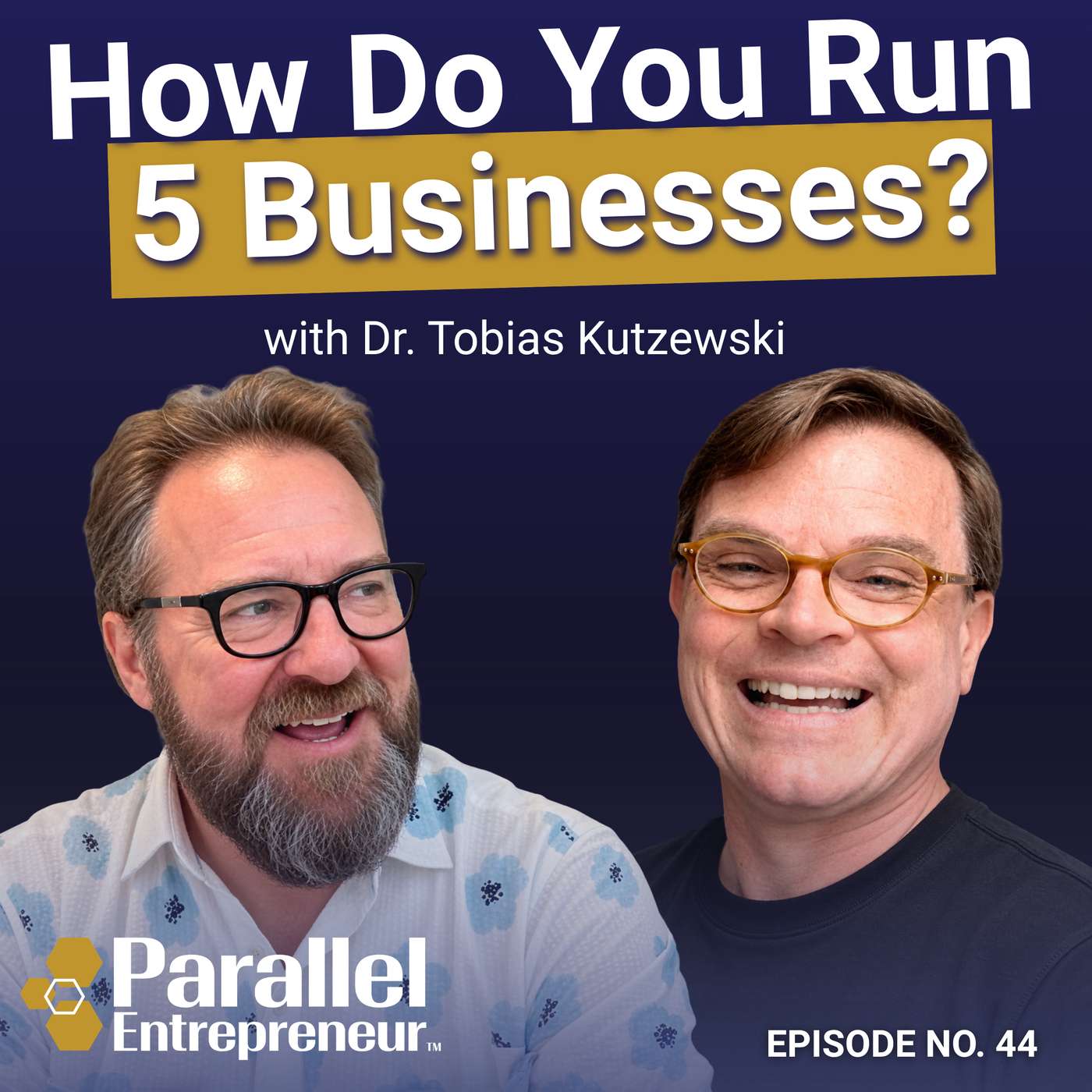
Episode 44 · Dr. Tobias Kutzewski

What It Takes to Lead More Than One Business | Dr. Tobias Kutzewski

Parallel Entrepreneur with Mark Cleveland · Episode 44

0:00 / 40:44
What It Takes to Lead More Than One Business | Dr. Tobias Kutzewski
0:00 / 40:44

Episode notes

What if running multiple businesses isn't a failure to focus, but a different way of operating altogether?

Dr. Tobias Kutzewski has spent years studying entrepreneurs who build and manage multiple ventures simultaneously. His research followed 21 entrepreneurs over time, examining how they allocate resources, respond to uncertainty, recognize opportunities, build teams, and decide when to explore something new while continuing to operate what they already have.

In this episode of The Parallel Entrepreneur, Mark Cleveland sits down with Tobias to compare that research with Mark's own experience of building multiple companies throughout his career.

They explore strategic optionality, the ability to prepare for and seize opportunities you cannot necessarily predict, and what happened when Tobias's research collided with the enormous uncertainty of COVID-19.

The conversation also gets into one of the biggest assumptions surrounding entrepreneurship: that focus must mean doing one thing.

In this episode
• What separates parallel entrepreneurs from serial entrepreneurs
• Why Tobias began studying founders running multiple companies
• What "strategic optionality" means in practice
• How successful founders divide their time, capital, and attention
• Why knowing what you don't know is a critical leadership skill
• The role of trust and talent when managing several ventures
• What Tobias observed when COVID-19 disrupted the entrepreneurs he was studying
• Why some founders become more opportunistic during uncertainty
• Mark's "pause, pivot or pursue" decision during the pandemic
• Whether resilience can be developed
• Why the economic impact of parallel entrepreneurship may be larger than we currently know
• Why younger generations may increasingly become parallel entrepreneurs

If you've ever been told you need to choose one business, one idea, or one path, this conversation offers another perspective.

About Dr. Tobias Kutzewski
Dr. Tobias Kutzewski is an interim finance director and freelance lecturer at the School of Business & Economics at Vrije Universiteit Amsterdam. He earned his PhD in entrepreneurship researching how parallel entrepreneurs initiate, develop, and coordinate multiple ventures over time. He is also the co-author of Strategic Optionality: Pathways Through Disruptive Uncertainty.
Follow Tobias on LinkedIn
About the Host
Mark Cleveland is an entrepreneur, investor, and advisor who works at the intersection of multiple ventures. As the voice behind The Parallel Entrepreneur, he explores how founders build aligned businesses, strong teams, and sustainable momentum without forcing themselves into a single path.
Follow Mark on LinkedIn

Subscribe to The Parallel Entrepreneur for conversations with founders, researchers, and leaders exploring what it takes to build, lead, and thrive across multiple ventures.

Learn more about The Parallel Entrepreneur and our growing community at parallelentrepreneur.com

Links & Resources

Follow Tobias on LinkedIn

Strategic Optionality: Pathways Through Disruptive Uncertainty — Surja Datta & Tobias Kutzewski

Explore Tobias's research at Vrije Universiteit Amsterdam

Unlocking Strategic Innovation: Competitive Success in a Disruptive Environment — Surja Datta, Sandeep Roy & Tobias Kutzewski:

Follow The Parallel Entrepreneur on LinkedIn

Learn more about Mark Cleveland:

Happy Overall

Related conversations
• The Science Behind Running Multiple Businesses at Once — the companion conversation with Dr. Tobias Kutzewski on the research behind parallel entrepreneurship
• Building Multiple Companies Without Losing Your Mind — Craig Fuller on stacking ventures and spreading attention across them
• Scale, Sell, Repeat — Roger Brown on building, valuing, and exiting multiple ventures
• The Comfort Trap Every Entrepreneur Must Escape — Joe De Sena on the resilience that carries founders through deep uncertainty
Chapters

Full transcript

Quick decisions can be reckless decisions, but not if you are a pattern recogniser. To each and every entrepreneur, it had to be very clear and very specific what their very own sweet spot is at a very early stage. We just gotta eliminate all the distractions. Eliminate all the distractions. I think you're eliminating points of insight.

In academic terms, we do make a difference between heuristic and causal decision-making. Causal decision-making is the very structured way of, well, setting a goal and working towards a certain objective. Heuristic decision-making is rather intuitive. It's quicker; it's less formalised. We're back with Dr. Tobias Kutzewski, a leading academic authority globally on the topic of parallel entrepreneurship.

And I want to pull our attention a little bit toward leadership. We've been talking about orchestration, opportunity, uh, mapping and the various different—and you'll even admit it—it's a little bit academic. And, um, I'm kind of curious that our listener might be saying, “Well, give me some specific examples.” And I think that if you could do that, that'd be helpful. Um, maybe under the lens of leadership.

Like, where is it that this is about leadership, and where is it that this is about rapid decision-making when you have a portfolio of companies that you're trying to, um, husband? Individual leadership skills, I would say, are probably the most important component, actually, to understand what makes parallel entrepreneurs unique, because I cannot recommend parallel or portfolio.

Entrepreneurship to everyone I would say that this requires certain skills, capabilities maybe resilience uh probably more so than even to cope with ambiguity. Being able to um run multiple companies at the same time. Requires a lot from people I mean Mark you know it yourself you did it in the past you know how many situations that probably were from your own experience where you said well.

Why on earth does everything come together now at this moment in time? And sometimes it can be uncomfortable, and sometimes it can be very very personal that you have to decide for yourself. Which of the ventures deserves more resources in terms of time capital uh human resources? Attention, and those dilemmas that might potentially arise I in my view are something very personal very specific and they require um certain not only maturity in decision-making, but I would say a certain level to cope with ambiguity to cope with mutually exclusive decisions.

With conditions that are. Neither perfect nor fully compress all variables, and you have to figure out for yourself down the road, what's actually well the most feasible way to continue with, and I'm personally actually quite quite curious with you as a seasoned um parallel entrepreneur yourself. Have there been in the past any moments where you thought?

I skip with at least a number of my ventures, and I focus only on 1 maybe on 2 was there something like that for you usually it came down to it's time to sell this business, and so the focus of my attention would be moving toward. I'm selling this one which you're wrapping things up and systematizing, and putting, standard operating procedures in place every day, but you have to look at the business differently, when you're on that trajectory and um it became a whole new set of decisions based on that objective that change of objectives, and then when that happened.

I had more time when it was, when that moment was passed I had more time to focus on something else I definitely had a company that was on fire at one point in time, where I had to step off my attention I was paying to Swiftwick, and step on to the attention that I was paying to Hobby Lobby actually. Yeah, I I had an embezzlement going on at at that company, which we discovered a very highly trusted controller uh position that had a scheme going on that was difficult to identify, but eventually we did and I had to had to address that um it took a lot more time and attention at that moment, but that would be an unusual circumstance.

Uh, back to ambiguity back to things that you don't anticipate um yeah I've had to make those decisions to to step off my personal gas pedal in one and in one enterprise and focus on the other. Um, and I was glad to do it just seemed uh you know in that case it was necessary I had I had an officer in the company die and die while uh you know being an important part you know not be able to complete uh this part of life's mission and you know what the business.

Was doing was completely irrelevant compared to that, but we all needed to make some adjustments and, and capture and catch that that family um yeah tough decisions um wildly different circumstances wildly different businesses you're always under some form of pressure, but let's just say you're in the swing of things, and you got multiple companies?

Do you see that parallel entrepreneurs make decisions faster or make decisions differently in academic terms we do make a difference between heuristics these general rules that we apply to that mostly covers the well? Most instances that we that that we come across and that work, and causal decision-making causal is the very structured way of well setting a goal and working towards a a certain objective it's more common in let's say the more corporate managerially inspired uh companies whereas heuristics um are more were frequently used in entrepreneurial firms.

You have a look on what you what resources you have at the moment um, and what can you do with it how can you allocate them how can you utilise them effectively, and what to do with that one, and in heuristic decision-making is rather yeah. I would say intuitive. It's it's quicker it's less formalised compared with a more causal way of decision-making that you encounter in um in bigger corporates.

I would say that some of the entrepreneurs that I was able to follow actually had a pretty neatly organised head office. Uh, a staff function with HR units that were doing the accounting and controlling organisation for for the ventures and actually acted more like yeah I would say a corporate head office or maybe uh a staff unit in a private equity or venture capital firm, so very similar actually to a rather causal may way of uh organizing and deciding where to allocate for instance.

Capital but um generally most entrepreneurs relied on their gut feeling, rules of thumb that worked quite good in most instances maybe not always but at least they were they're allowed entrepreneurs to make a quick decision to not overly formalize, and decide what other alternatives um might come up with, but to decide quickly into which direction to um to venture yeah, and I think that quick decisions.

Can be reckless decisions, but not if you are a pattern recognizer and you you are deeply involved in the business you get feedback from the millions of different sources, and then you just make a decision I think also at least in my experience? We tend to stay committed to our mission or committed to the outcome, unreasonably so in my case sometimes where you just keep on uh you keep on keeping on um, so I was curious if you had some experience where multi venture founders are they wired the same.

Or are there different types of people that are doing this well personally found very intriguing was the similarity across. Basically, all entrepreneurs being. Very yeah almost likable approachable um great communicator um you really saw that they were really eager driven and, and friendly to share their insights not only with me, but you could clearly saw that how they responded and reacted to to other people so they were they.

It was really actually great to see, because they had such a huge. Diversity in people around they were quite accustomed to that and enjoyed it a lot, so I thought this mix actually of being um able to rely on your own gut feeling, but also being able to structure and organise once that is necessary together with this approachable.

Very authentic way to to well communicate or something for me I found deeply intriguing with with most people that I spoke then yeah I think this was one of the common denominators that I basically saw there is the world moving toward more multi venture founders. Or is this still a niche to be explored and studied I wouldn't be surprised that in the future that we would see more of this this phenomenon more people developing uh those skills more people being able to utilise the technological technological means and also more people actually being willing to endeavour, because we do not know how the future is unfolding, and maybe even see the world.

Beauty of this uncertainty to say well I pick a few spots that I want to develop. Maybe not all of them were I will be able to harvest, but sooner or later some of them might might prosper what's your view on that one I mean you have the experience, and you are connected with numerous people in the field. Do you see an increase in interest or is it?

How does it look like I really believe the younger you are the more likely you are to be a parallel entrepreneur either right now or real soon I think we all have heard the cliche or I've heard it said to me wow how do you manage the chaos? I mean well well what would happen if it's not chaos what would happen if it's highly organised.

Uh, passion driven resource allocation made sense what do you think that academia still misunderstands about the people who are operating this way, and where do you think that the practitioners are getting out ahead of the research well practitioners of course are something well. Of a certain breed there well yes it's it's great that you know something it's great to well to form a new uh new insights gain more knowledge about something, but this always has to serve a certain goal.

It has to work you have to make well uh either run your company more effectively or efficiently being more innovative in what you do. Easier able to adopt leadership those kind of well elements of course are what what practitioners are looking for in academic research, and something that I would say most academics are less able and less.

Willing actually to well to develop or to suggest and to most academics it's yeah it's something practice journals or book publications. Uh, that are dedicated to practitioners to managers to business people to entrepreneurs. Are not the highest ranking publications you can come up with well, but I would say these are the ones that actually make it worthwhile to actually do academic research, because then you translate knowledge into something that people are hopefully able to use for their daily work for well?

Making decisions on their uncertainty for well developing a skill set that might well provide them with better capabilities to well to run their companies yeah this is the best part about this conversation for me is that I hear from experience. You address question decision action. Structure organization I hear you speaking to it, from this deep perspective of your own business background, as well as from the study, and uh it's a joyful thing for me I'm like alright let's let's talk more about that cause um I'm I'm curious about the idea that do you.

Find multi venture founders are filtering opportunities like what separates a yes for them from a distraction. Um, and I think I'm very aware of distractions, and at the same time those are sometimes the kernels of the discovery the learning process to a opportunity, so a lot of people will say we just gotta eliminate all the distractions eliminate all the distractions, and I think you're eliminating points of in points of insight uh, when when that's your perspective, but there is ultimately a decision.

A yes or a no or a inaction decision that has to be made, and I'm curious what did you see the founders use as their filter for that I think the most important thing is for each and everyone that I came across first was a very individual. Um, understanding that they were specifically able to contribute to a certain venture a new idea um either because they knew marketing either because they knew uh technology either because they knew how to um make a startup into a scale up organisational um leverage.

To each and every entrepreneur it had to be very clear and very specific what their very own sweet spot is at a very early stage, and if there are great opportunities, and nothing that well fits their own skill set their own capabilities then um it can be as good as potentially possible. I would well what I saw is people still neglected see it as a, as well moist in in their decision-making funnel.

Because they knew that they were not able to complement the requirements of a new venture with their own skill set, and everyone was able of course to also organise complementary skills. Um, to introduce them to new business partners. Um, to external financing not every form of everything was financed by their by their own well uh capital base or slack resources.

It was always necessary well to also keep other keep other people uh involved and attract new talent, but in the core it had to be fundamentally clear to each and everyone before starting with something that there has to be some added value at a very individual level. That those entrepreneurs were able to present with, and this could be everything actually my friend Brandon shared a piece of advice recently.

Dress, so that if someone dressed up as you for a costume party everyone would know it was you. Now, that's not entirely about clothing that's about identity about showing up fully. My wife Jenny and I are leaning in on this concept both in our personal lives and now in a little startup we call Happy Overall we're making overalls.

Each one is made to order as a wearable canvas for art. Overalls that are comfortable durable and expressive. We're sourcing soft 100% cotton we're partnering with designers, and with local seamstresses, who love the artistry of a well crafted piece of clothing. So, check out Happy Overall.com to see pics and see if anything resonates with you, fully you, and it'll happen every time you reach for them, if you want to be part of the first run join our waitlist at Happy Overall.com.

What's what's your skill set actually that you think well. That makes you worth more to develop a venture I think the answer for me is that I'm a super connector I track talent I recognise people who have talent. I make sure I have all their contact information I make sure that I'm in a position to know how they're progressing with their career uh, because I'm a cheerleader for them first, and I like to see people be successful and help them, and then there might be a moment down the road, and this has happened many times.

Three years five years seven years later I've got something that's really interesting, and I know that person, and I know what their skills might be, and what their passions might be, and I paid attention I just listen, so I think my first superpower is listening. My second superpower is connecting the dots helping people get where they wanna go um whether they're in my organization or not, and not having any expectations from that you just never know where those deposits are coming back to you or where those people are.

Then taking that example that experience, and making deposits in the equity relationships of of the young uh you know the young student the young entrepreneur the family member that needs some support, and encouragement and good advice, and everybody is paying it forward, when it comes to business. I think I'm decisive I think I'm I think I make decisions, and then I am not afraid to revisit those decisions, and not in something that would drive me crazy like a chaotic form where I'm deciding this, and then the next minute I'm deciding that or I've had some experience with partners.

They decide something, but they are always looking over their shoulder trying to figure out well was this decision right or wrong, and you're not really truly committed to it you're not surfing the wave you're wondering if the wave behind you was bigger or not um I find that managing in the rearview mirror is not very helpful.

At all, so I try to spend most of my time in the windshield and uh paying attention to the the moment of now, there was a point in time where I used to wonder. Where there is a tradition in America that some of us old enough to remember the company you retired at was the company you started at, and you got a gold watch, and you had an entire career there, and then then it became this era, where you had more short stint careers, and you're climbing the ladder, and you had to leave your organization, and go somewhere else in order to get new skills?

Responsibilities or to advance. Um, and I had been presented more than once with why why don't you just continue in the transportation industry or why don't you just continue in the software industry or how about the satellite communications industry you're an expert in textiles now you're literally. As close to a functioning expert in textiles I am um maybe as I as I care or need to be, but gosh um then I would I would start a different company that was doing something completely different that I was interested in short sea shipping.

It's not that I got bored, and it's not that I knew everything about that industry, but the velocity of learning slowed down, as I applied all my business expertise, and then all my I gotta learn this and figure this out uh practical hands on experience. These are intense learning periods at a startup or when you're trying to create another division or another product in your company, and I just really like the the volume, and intensity of learning something from scratch brand new I also think that it tends to keep me from uh I don't.

I don't enter that industry with a bunch of stale ideas about what can or can't be done, because I've not been in that industry before, so I wind up getting lucky once or twice by having uh no preconceived notions yeah it's a beautiful characterization. I would say because it's so much connects the way you behave and you organise, and what you do with how you are.

Well, how you generally see yourself as a persona, and what intention and interests you have to learn to develop yourself um what we initially talked about well those leadership skills they are I would say essentially well abilities to decide. Even despite a lack of full knowledge of everything, and an instant moment with the available information.

To continue to go on, and I think that life essentially is a process it's a constant flux of of movement of a ongoing decision that you have to make I've definitely seen companies that were so rigid in their approach this is the way we've done things. That the entire culture of the company is cement, and they're believing it too this is the way it's done, and they're brittle and inflexible and you know that's a problem great things can come out of very minor adjustments uh if you do something for 100 years.

Um, and it's perfect well yes maybe you are still able to improve it slightly, but do not fall short on the Assumption that things are not changing and yes some areas are indeed rather stable, but most I would say are not, so make for yourself. Be for yourself flexible in deciding what's what to adjust and what not to, so tell me a story from these one of these 21 entrepreneurs something that you think you can sanitize and share with the audience.

What was the funniest thing that you experienced um while you were doing these studies, an entrepreneur um from a very humble background and he started with a with a friend um in uh social social care services um built uh his first company um another one? Another one was still well engaged and involved in in all the prior ones, and he saw this very much as a learning cycle, because in the end well when I spoke him after I think he was there 10 10 15 years ago.

Years in this in this trajectory and then he said well I decided for myself to move into into investments and seeing actually more not only as um yeah capital investments he was interested in, but actually well smart capital, so combined with business coaching. Combined with his own guidance to well actually develop companies not only provide them with uh, as angel investor with some some capital injection, but with his knowledge that he had he gained and he uh he's now uh also an external advisor to um to a major bank here in the Netherlands and I was.

I thought well this is actually quite fascinating to see is that people see, their knowledge base as stepping stones to work new new levels new activities and um he was very given his very humble um background he was very open to be to be uh approached by by others uh seeking his assistance he never uh yeah. There was no doubt that he was uh willing to participate in my own research, because Emilio said well.

Dude I'm I'm fully yours and I despite the fact that you had a very full agenda for everything, but come and share, and let's talk about it and reflect on this one, and I thought that this combination was uh was for me at least uh one of the most enjoyable. You know you talked there briefly about he had a full agenda I live with a very full agenda, I'm reflecting back my wife said something to me last week she said Mark.

You have more tabs open in your in the computer of your mind than anybody I've ever met, and she likened it to like, and I right now I have in on front of my screens here I have 30 or 40 open tabs and it can get worse. I also have systems that I use for this I my AI brain you know things that I've I've developed to be a resource for me and, and they just help me cinch things down finish things up get it to a point where the next decision can be made.

Or the goal is achieved so I'm I'm thinking about the nature of being goal oriented, but I'm not just going after goals I'm aggressively pursuing the things I'm curious about. I'm feeling what I'm not good at, and deciding to try to get out of my comfort zone, and go do more of that until I'm no longer uncomfortable with it, and so I use discomfort as a windsock, and I'll lean into the wind.

And then it's coming from this direction, and I'm feeling ill prepared. Uh, like I don't know enough, and I'm going to just go lean in that direction and pursue that curiosity until I discover that there's really nothing to worry about or there's there's really an opportunity here or there's not right we have to discover and determine that there's not opportunity there.

Um, yeah I'm I'm I'm. I'm sitting with this idea that uh finishing what you start is a superpower. Um, being able to track. Multiple human contributions and system contributions to a thing that is organised, as a business. Being able to be organised we talk about it in the in terms of business leadership always we talk about successful delegation, and we talk about recruiting and talent.

But I think you cannot hold on to every little detail, as a parallel entrepreneur it forces you to fully delegate and operate in your superpowers, and that is I'm getting as much out of this conversation I hope as as our our listeners are because I'm. I'm feeling like oh wow. Being forced to completely delegate because that it is necessary, in order that I can continue to pursue my curiosities.

I think that is a part of why organizations come up and get born and live and survive in my wake I think there wasn't a single entrepreneur that I spoke with in my uh in my sample. That did not fundamentally acknowledge and point to the necessity, to rely trust on other people, and being willing to delegate a responsibility.

Still share responsibility of course being finally the last one who is well accountable for things going into a wrong direction, but sharing the the great moments together with your team, and being willing to support them delegating authority moving. Maybe a little bit to the rear side, and letting others move forward.

Their attitude toward obstacles is also different. They don't run up against an impossibility I see, so many people get up against a block and just stop. Most of the time talking themselves out of something that they began, as a journey a business a a vision and just talking themselves out of it I actually think we talk ourselves out of great opportunities more than we get close to them, and in my own experience.

I've seen parallel entrepreneurs tend to be more capable of, and more flexible in their approach to growth, where it's not just organic growth, and they're busting Teaster trying to get you know this 10 20% 30% whatever the whatever the organic growth number looks like, and yet now. They think about mergers, and acquisitions as a methodology of growth do you see that in your research we saw in multiple instances where indeed mergers and acquisitions so as strategic investments either in related or unrelated companies.

Um, was something that people actively pursued, and saw this as a what it's frequently called a lateral a growth strategy so not only growing in terms of um the core business company to to well to form a conglomerate so to speak, but more also as a way to well. To strategically invest in certain areas where financial resources slack resources were available and more important um, and a certain intellectual interest, and fit with one's own capabilities makes sense to actually pursue a strategic investment, so I think it had to meet more than one requirement.

To be an active uh acquisition strategy mergers and acquisitions are growth. Through finding synergies in the acquired entity that has been combined with or that consumes your entity, and you still have a part to play in it it does sort of give you the one benchmark for, when you start a company and sell a company. That value that you created you're being prepaid for the next several years of potential that that you created, and brought to a point that then became acquired or became the acquirer, and those are some of the benchmarks for how we view whether we were successful or not,

and I tend to look at success from a lot of different lenses. Not just a financial exit but you know how did I impact my community how did I how did I grow. Years later some wonderful employee or team member might contact me, and talk about the lessons that they Learned in this window of time that they're just now uh feeling as accessible to them like hmm, and I Learned this and I'd I'd like to attribute that to you and thank you.

You know it's a real gratifying part of just living a a contributor's life I feel like it's not just about the money. For any of the entrepreneurs that I speak to and, and increasingly, when they're tend to be more parallel entrepreneurs I don't find that they're doing parallel entrepreneurship for the money. I find that they're doing it in order to completely satisfy what it is that drives them internally they found a formula that works, they have some pattern recognition skill sets, and some leadership skill sets that work, and why not just start another company.

Why not where those those parallel portfolio entrepreneurs that I spoke with um I think sooner or later we always reach a point where somebody made a joke about his or her well diversity of interests and that they found? Well, um an efficient way to keep themselves out of a pub or to um well, and an another entrepreneur confessed to me that well he was just initiating new companies.

Even if it wasn't necessary at all uh given his financial background. Just because he did not want to annoy his wife all day long and sitting at home or golf was too well too boring to do seven days a week, and should not be too much to do, because two or three days a week was just perfect. To him so there was this always this play of what's, what's a hobby uh how much do I value my own um time my my my hobby interest my precious moments that I care for, but always in combination of well.

It's also good for me to have something um on my plate to do to figure out how it works to learn to well get my teeth into because otherwise yeah my wife kicks me out because I get too annoying at home or I start cleaning. Who knows the the backside of the bookshelves every second day, and something like that what was the pattern that you saw in the entrepreneurs that you studied and how they dealt with stress?

Saw a number of uh instances where people were very actively. Uh, addressing the fact what they did for um both physical as mental health. And this could be everything um ranging from um frequent regular workouts endurance sport uh indeed yoga, indeed people were always well, driven by some things where they could. Uh, physically well switch their mind off the brain and do something else go swimming every day uh in the morning first thing um

going for walks for business lunch uh instead of well taking taking a seat somewhere. And I thought that this this was really intriguing, because it's so much reveals with my own pattern with what I also do just to yeah. I always like to do each and every day something, and I'm not an expert I'm not a full athlete and also, but I do like to have a workout in the morning I do like my running I do like my yoga and those things do well.

Just have to happen without well much much of an effort and, and those portfolio entrepreneurs. They each and every one found something that they deeply cared for, and it was I would say practically impossible to imagine, a good and healthy life to them without those kind of physical moments of relaxing. For me it's getting up in the morning and going to hot yoga it has to be the immovable object then I start my day so I just don't allow anything to start until after this period of time, and sometimes I find that they get involved in uh competitive sports like cycling or triathlon.

Or something that requires some dedication, and they may not try to be first place finishers many of them do but I also find that they that just is getting something on the calendar um one of my guests Joe Desena recently said you just gotta get something on the calendar, and you always have a goal for that, and for business person.

It might be the quarterly report it might be the annual it might be the annual report it might be L10 for your EOS operating companies it could be something as simple as board meetings, but they're always on the calendar, and so are your physical your dead. The dedication to your physical part of your body, and this lived experience I think and I think it can be quite complementary I mean most people were very much aware to to have social contacts besides their well let's say commercial or more business related interests, and each and every one addressed the fact that it was, so important to talk with their spouses.

Family members children not only about business related, but also about just well. Having good time together just well to root and to settle down with all those well, balls you have to juggle at a daily base, but besides this mental mind. Uh, fulfilling fulfilling activities each and every one had something where well physical attitudes were playing having something physically engaging was was important being able to have a sustainable level of energy.

Think requires certain kind of well care. So, to speak yeah a little self care goes a long way. Well, thank you for joining me on this extremely interesting academic and, and personal exploration of parallel entrepreneurship, and the portfolio mindset of multipreneurs, and helping us with our research that's ongoing and being a resource for myself.

The team and everyone who's listening Tobias this has been an honor to sit with you, and I appreciate that you're on the other side of the world um and we're we're working out uh how we found this time and it's been beautiful thank you so much for joining us Mark. It was a huge pleasure to meet thank you hey Hey, thanks for listening to the Parallel Entrepreneur, and thank you to our sponsors, partners and the amazing team behind the scenes who help make these conversations possible.

If today's episode sparked something for you, be sure to follow, subscribe and please share it. Learn about our growing community at parallelentrepreneur.com, including details on our mastermind and companion programs designed to help you align, grow and thrive across multiple ventures. And, of course, gratitude to every visionary guest who trusts us to share their story.

Until next time, keep building in parallel.

Building more than one venture?

The Parallel Entrepreneur Network is a private, vetted community of founders running multiple companies at once. New to the idea? Start with what a parallel entrepreneur is.

Apply to the Network

← All podcast episodes