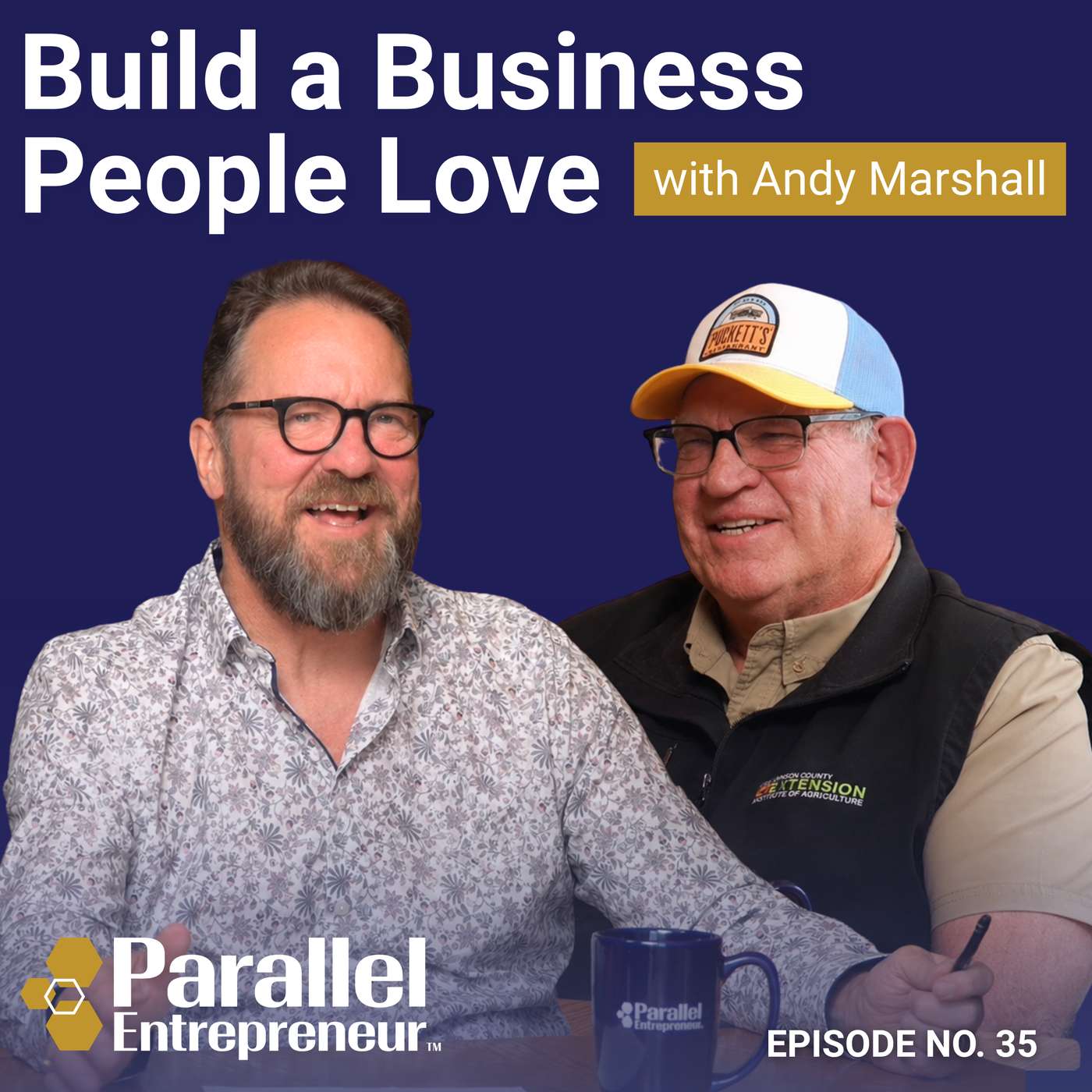
Episode 35 · Andy Marshall

What It Really Takes to Build a Brand People Love | Andy Marshall

Parallel Entrepreneur with Mark Cleveland · Episode 35

0:00 / 1:08:50
What It Really Takes to Build a Brand People Love | Andy Marshall
0:00 / 1:08:50

Episode notes

Most people think they're building a business.

But every now and then, you meet someone who's building something deeper—something rooted in people, place, and community.

In this episode of The Parallel Entrepreneur, Mark sits down with Andy Marshall, Founder & CEO of A. Marshall Hospitality and the driving force behind Puckett's. From his early days in the grocery business to transforming a small market with two gas pumps into a destination known for food, music, and connection, Andy's journey doesn't follow a typical path—it evolves with purpose.

Puckett's didn't grow because of a playbook. It grew because it meant something to people. And over time, that approach hasn't just worked—it's scaled, without losing what made it matter in the first place.

Now, Andy is stepping into a new chapter, running for Mayor of Williamson County. Not as a career politician, but as a builder shaped by decades of leading teams, serving communities, and creating places people care about.

In this episode

  • How Puckett's became more than a restaurant—it became a community staple
  • The discipline behind long-term growth
  • Why community isn't a byproduct—it's the foundation
  • What it means to lead beyond your business
  • Why stepping into public service felt like the next right move

This isn't just about hospitality. It's about building with intention—and carrying that into leadership at a different level.

Connect with Andy Marshall

Follow Andy on LinkedIn · Puckett's Restaurant · Vote Andy Marshall · About Andy Marshall · Andy Marshall on Facebook

About the Host

Mark Cleveland is an entrepreneur, investor, and advisor who works at the intersection of multiple ventures. As the voice behind The Parallel Entrepreneur, he explores how founders build aligned businesses, strong teams, and sustainable momentum—without forcing themselves into a single path.
Follow Mark on LinkedIn

About the Guest

Andy Marshall is an entrepreneur who built his career the long way, starting in the grocery business before transforming a small-town market into what is now Puckett's, one of the most recognized hospitality brands in the region. As Founder and CEO of A. Marshall Hospitality, he's spent years scaling a business without losing its identity—focusing on experience, consistency, and community. His work reflects a belief that great businesses aren't just built to grow—they're built to matter.

Related conversations

Why Community Is Nashville's Superpower — Rod McDaniel on why community is the region's real competitive advantage
How Christian Paro Built the Coolest Co-Working Space in Nashville — building a beloved place people gather around
Why Great Businesses Need Stewardship, Not Just Capital — Douglas Song on succession and building companies made to last

Subscribe for more conversations with founders, investors, operators, and creators building extraordinary lives across multiple ventures.
Chapters

Full transcript

And we always went to Sunday supper and I would be telling him about my week, you know, tell me about your week, son. And I'd tell him about the stores I visited. And boy, if they would just merchandise this store better or if they would staff it properly or if they'd clean it up, I'd say these things. He said, "Son, you sound like an entrepreneur." And I said, "I've never really thought about it." He said, "Well, there's those that talk about it and those that do it." He said, "I think you're a doer." Welcome to the Parallel Entrepreneur, where we explore how founders, creators, and visionaries bring multiple ventures and parts of themselves to life. In

season 2, we're keeping the conversations real and wide-ranging about alignment, creativity, and the messy, beautiful art of building in parallel. It's not about doing more. It's about letting our ideas work together. This is the Parallel Entrepreneur. Conversations on the Parallel Entrepreneur podcast are about people, and most people think that we're talking about building a business. Every now and then, you run across someone who's really building something else entirely, something that lives a little deeper in the community. Andy Marshall is one of those people. From his early days in the grocery business to founding a Marshall Hospitality, his work has consistently centered around creating places that

bring people together where the experience matters just as much as the product. And over time, that approach hasn't just worked, it's scaled without losing what made it special in the first place. This is a conversation about building with intention and what it takes to grow without disconnecting from your roots. Andy, welcome to the show.

We are um I'm so thrilled to sit down on at across the table from you again. I know it's been a while since we've been actually face to face. Yeah. Yeah. It's good to see you. I'm super excited about my very first experience when I moved to Nashville when I got out into the countryside and discovered this place called Puckets Grocery.

Oh, amen. It was um 2000 when I moved uh to Nashville. And you just you what you started that company in '98. 98. So I'm toodling through the beautiful countryside of Middle Tennessee. Don't even really know where Leapers Fork is. I just ran into it and discovered it and went inside. Um, and one of your innovations was to bring music and a real approachable experience into a grocery store and a diner and integrate those things. And I was looking around going, "What in the heck is going on here?" How tell tell tell the audience tell our friends how you became an entrepreneur and brought this vision that began that

story that began this you know today's evolution of puckets. Yeah. So you know to to think about when I knew I was an entrepreneur um right out of college. You remember the college recruiters come when you're when you're finishing up college and you apply for jobs before you ever finish. And I applied with Lever Brothers selling soap and I had been in the grocery business my whole life selling soap.

And um I never um thought that's where I was heading. I always thought I' I'd you know go right into back into the grocery stores. But anyway, I took that job and as I was um selling soap around Middle Tennessee and and I would come home um my dad always had a Sunday supper and we always went to Sunday supper and I would be telling him about my week, you know, tell me about your week, son. And I'd tell him about the stores I visited and boy, if they would just merchandise this store better or if they would staff it properly or if they'd clean it up, I'd say these things. He said, "Son, you sound like an entrepreneur." And I said, "I've never really thought

about it." He said, "Well, there's those that talk about it and those that do it." He said, "I think you're a doer." And at age 26, I bought my first grocery store. So, I've been an entrepreneur most all my life. But the leapers for journey I'd so I had built my grocery stores for four grocery stores and I just didn't see a long-term vision for the independent groceryer. I'd won groceryer of the year. I'd been given the spirit of America award by Congress by some innovation in the grocery business. But as I um get to a certain pinnacle, people want you to mentor, right? And I was mentoring and I was talking some generational businesses. third generation and they still had debt. And somehow that shook

me to think, how is it that you took this over from your dad, your dad took it over from his dad and y'all still have debt 40 years later? And the grocery business question, right? Right. Right. And so the grocery business is one that it takes a tremendous amount of capital investment because you have millions of dollars in inventory and then you have a bunch of equipment and the equipment during that time was changing and innovating and so you were constantly having to reinvest and I just didn't see a way out of debt and I felt the urge to get out of debt.

So, I sold my four grocery stores and um and I'd like to say I found Leapers Fork, but Leapers Fork really found me. A couple people called me about this little market there. Hey, you're you used to be in the grocery business. Come out here and buy this grocery store and help us. Well, it wasn't really a grocery store. It was two gas pumps and about 2,000 square foot of of shelving, 8ft meat counter, 8ft produce. It was tiny. But I thought, you know, I can fix this up. I can clean it up, fix it up, and I may flip it. But in that journey, that entrepreneurial spirit kicks in, and you you start thinking, how, okay, how do I make this work?

People are so mobile now, they're not going to buy groceries here. They're going to drive right by you and go to the big, you know, Kroger's or Publix or wherever was more convenient and could offer more. So, how do I make it work? Well, the I started cooking and the cooking became a calling card. And then well, how do we get more people to experience the cooking? We have all these beautiful songwriters in our community and the relationships led to the dinner program and and and music and and then it set us on a course that um really changed the rest of my my career.

Yeah. You know, we now sit there with 11 restaurants across Middle Tennessee and one in Alabama and never thought from two gas pumps that that's where we were heading. you I I remember that there was a movie night and we would go out back and watch movies uh and listen to live music in a grocery store and you'd uh have some of that awesome barbecue brisket. I mean, and it was so small that was like this maybe so quaint and personal and approachable. you managed to make that feeling continue in the new restaurants that you've opened. Um, how do you how do you keep that formula going?

Right. So, you know, when you go from one to two, that's that's the big question, right? Is how is it duplicatable? Do do we really have something special or is it only special for here? And that question was u was rolling around in our head when we started seeing people sitting in the parking lot with their tailgates down or their trunks open because they couldn't get in the restaurant and they were eating our food sitting in the parking lot. And I told my wife, I said, "We either need to expand or we're going to we're going to die on our success right here. People aren't going to do this forever, right? The inconvenience of something that cool." And you and Jan

have been married for 42 years this October. So it really was you were newly weds. Yeah. Right. Yeah. Kind of. Sort of. Yeah. Hey honey, we keep it newly wet all the time. That's good. Yeah. So um so yeah, you know, we and then we found that location in Franklin and lo and behold, it it became duplicatable. it we it was different but still had that feel of it used to be a grocery store and now it's a restaurant kind of question when people came in and they found that fascinating and um almost like mom and Paul had to push 9 minuteseverything to the four walls and then had to put some tables in to survive and truly I mean that's kind of in truth

that's what happened but it became now a a concept I used to ride my bike. Jenny, my wife Jenny and I would ride our bikes from Brentwood down to Leapers Fork and and the destination was launch at Puckets. Yeah. And then there became like the Harley-Davidson group and the and the and the secondation. Yeah. Um it strikes me you were in the grocery business which I perceive to be a very difficult business. It is gigantic big box retailers. You're an awardwinning ger. Then you pick what I also perceive to be an extremely difficult business which is restaurant.

Restauranting. You're a restaurant tour. Yeah. Um why why do you like big challenges? And what is it about these experiences? It's just you got there. You can do anything, right? If you can run a 500 person organization, you can pretty much do anything. But you didn't pick easy businesses. Yeah. Yeah. I've had many people like yourself look me in the eye and say, "Why would you go from the second most failed rate business for an entrepreneur and go to the first rated fail rate business as an entrepreneur? I I never looked it that way. I you know um I was raised in the grocery business. you know, when my dad took me in at age 13, I um he was a grosser and I just wanted

to please him and thank him for for taking me in. And um and so it became just do good at whatever you do kind of mentality. And so I I was really good at being a grosser. And then um later, you know, when I built my business and sold it, I you know, Leapers Fork really found me. I was just it really was just going to be a short-term project. But then that entrepreneur side kicks in and I started following passion.

And that passion then became, boy, I love to cook. Always did. And all my grocery stores, I always wanted to have scratch delies. I didn't want to buy it in a box and put it in a box and put my label on it. I wanted to cook it. I wanted it to be fresh. And so I started doing that out in Leapers and and you know once I put that smoker out in the parking lot and I'd go out there and open that lid every time there was traffic you know and people would pull in and what are you cooking you know it was it became a became a fun thing. It smelled great out there. Absolutely.

Before people really understood to just go ahead and cook outside. You were doing it. Let's drill in a little bit on this. you're grateful for your dad taking you in. And you mentioned mentorship already in our conversation and those are two, you know, some of my favorite topics are how you mentor, how you're how you've been mentored.

Um, but my dad taken me in. Let's let's unusual way to describe your beginning journey. Yeah. So, um, my mother and father divorced when I was two years old. He he was coming out of the military and at two years old they were divorced. So I never knew him from that standpoint. I mean he was gone in military comes home they get divorced and so she's a single mom raising three kids. I had a brother 7 and a half years almost 8 years older than me and a sister four years older than me. So they had a little more understanding of the my dad than I did. And then in those days, you know, the dads didn't get a

whole lot of rights. I saw him uh two days at Christmas and two weeks of summer. And that was all the relationship I had with him. And so over the time of of um living with my mother, he remarries. My brother leaves the house at age 15. I'm seven. U because he can't take it. Whatever that was, I didn't understand it. And then my sister became a runaway when she was 13 years old and got into the hippie movement.

And then the abuse started on me. And I systematically he worked through each of us. And I I didn't really see that in my brother or my sister. I just was safe at that point. When I became unsafe and it became my turn, um it it it it was not good. So, there were several things that happened that kind of kept me sane. The Boys and Girls Club, um, a police officer picked me up on the streets of Memphis when I was 10 and said, told my mother he didn't need to be out on the streets during the day. He he needs to be in school and then he needs to be at Boys and Girls Club and you need to pick him up there. And and so, uh, having Boys and Girls Club pouring to me was an important part that kept me through that period. And then

later just friends that took me in when things were tough at home, you know, let me sleep at their house and different things. it when I turned right when I was turning 13. I may have even been 12 at the time and I was growing and I had found the Lord and I found this new boldness in the Lord and I started pushing back on the abuse and um got in a real physical fight with my stepfather and the that day when I came home I didn't want to come home until she was home thinking that would soften it a little and I walked in the door and they were sitting at the kitchen table and she said sit down and I sat down and I thought I was going to get the hey you you you need to be respectful. You can't y'all can't do this kind of talk and he slammed his hands down on the table.

Almost flipped the table up. He hit it so hard and he said either he goes or I go and it caught my mother off guard and 15 minutesshe looked over at me and she said, "Do you have a place to go?" And I said, "Yes, ma'am." So they made me call my dad in front of him and he had already told me at Christmas that I'd asked him then when I was 12 if I could come live with him. He said, "We just can't take you in. Uh we just can't do it, son. You need to work it out." And so I had already knew his answer, but when I called him, I kind of faked my way through the conversation for my parents, for my mother and stepfather to think that he was going to come get me and said, you know, he didn't want to pick me up here. he wants to pick me up

at Troy's cuz he didn't want any kind of confrontation. So, I packed my bags. I went and started living with a friend and um and it was about 4 days later he called to check on me. My mother said, "I thought you picked him up." She he said, "No, I told him I couldn't take him in." She said, "Well, I know where he'll be if you want to come come talk to him." He came and with my stepmother. They drove up. They lived in Franklin at that time. and they drove up and um came and talked to me and and my dad said, "I don't know how we're going to do it, but we'll figure it out. Come on. You're you're coming home with us." So, that's how it started. And then you land softly in Williamson County and your

life changed. I saw I mean, the schools and and friends that I've made that are still I mean, I I'm still best friends with the very first person I met in Williamson County. I mean, where where does that happen? You know, Williamson County, that's the kind of place this is. And it it literally saved my life. Gave me a foundation that I that really led me to the success I am today.

More than you wanted. No, it's it's just um it's super authentic and I'm grateful. I'm sitting here talking to a friend who uh has shared a story that you know I can't do anything except say that feels a little bit like trauma and you know you have coping skills that helped you be successful and you also are a terrific leader which is evidenced by everything you've done in your life everywhere. Um, how how did how did so that that moment where you were on your own, taken in, coached and received and then mentored really um you you it translated for you into leadership skills.

Help help me understand what what leadership lessons that you have. Yeah. So, you know, when you look back on on that period of life, I never thought of it as any regret, when you talk about leadership, my stepfather was a con artist and he would con his way into us having an apartment and he was going to be the maintenance man. And so, you know, we we're moving. We're going to a new place. I got a new job. and and uh and that's what it felt like to me is like everywhere we were moving, I went to um 12 different schools before I was in seventh grade because he was constantly running for not doing the job that he was hired to do or bills that he wasn't paying.

I didn't know that. I just thought we were moving. I hope this next place is nicer than the place we're leaving. And um and some of them weren't and some of them weren't. But um when you go to that many different schools, you meet that many you you learn how to um to adapt and adjust and make friends and and so I learned people skills really early to get along and to fit in. And uh I learned how to read people who who are the people I want to be friends with and who are the ones I need to stay away from. And and so I learned some some life skills really early. And then when I had a chance to exemplify those in a better setting, um, people were drawn to

me because I was a natural leader. I just had had just the easy to get along with, easy to talk to. You know, my stepmother, she one Christmas when we were all together, she said, "I want to just make a statement right now." And she was in her 70s then, and she said, "I want to make a statement right now. Andy was the best of all of you because No pressure.

No, he was the best of all of you. He he he got up every morning. He made his bed. He came up to breakfast on time. He was ready for school on time. And and I I just chuckled. I said, "Well, you know why?" I didn't want to hear those words ever again. You got to go. So So I was a good kid. you know, I had I really took took it as an opportunity to almost like I put on a different cape and I just like, okay, this is who I can be now. I can take all the life skills I've learned and I can do them for good and it's just always the way I've looked at it. So, yeah, I like it. Uh, even described as a superpower. um in parallel entrepreneurship and we we talked about this a little bit earlier in parallel

entrepreneurship we are operating more than one company at the same time. Yeah. And I've watched you do paralleling and parallel entrepreneurship which is a different thing than serial entrepreneurship. Right. And uh which I've been accused of most of my life being a serial entrepreneur. Yeah. It never sat well with me. I I I was greatly appreciative of any of these. I mean, you and I have shared some awards, uh shared the stage, been on shared boards.

Um we've had opportunities to work together in the community and to build employment for our community and uh and we keep doing it. You know, this you are an entrepreneur. You said earlier, you you have some superpowers. 21 minutesUm, what are some of your other superpowers? Well, um I I have the ability and sitting on your side of the table. I can sit on that side and understand when somebody is trying to argue a point to me or trying to sell me something or even disagree with me. I have the ability to sit over in that person's chair and and hear them and then come

back to my side of the chair and express my feelings without it ever being an argument. I've always been able to do that. I've had people come in hot and heavy before. you know, when you're in retail and and there's always opportunities to disappoint somebody, you know, when you have employees and you have, you know, food and you have all these elements of um something could go wrong in that experience and somebody be upset. I've always had the ability to to calm and say, we call it falling on the sword, you know, just be humble and appreciative of the fact that they have a complaint and how can I make it right? And you're getting feedback, getting feedback, learning, always

knowing there's, you know, in a in a heightened conversation, even emails these days, right? It's always heightened to a an uh to a level that pushes it to an untruth. You've got to not just throw it out for it's untrue. You've got to say, "Okay, somewhere in this there's a message that they wanted me to hear and let me address that message and let's make sure we can find out what that is." And so when you conversate with people and you just have a conversation, you say, "I really want to understand what you're trying to tell me. Can you put it in words that you know I can understand where it's not an argument or it's you know you're not in this heightened state and see the change in their demeanor that oh he is going to listen to me.

People just want to be heard I think first. Um yeah I wanted to drill a little bit in on this community. um the sense of community because you you talked about a police officer that intercepted you and brought you back into the Boys and Girls Club and helped guide you as a public servant. Um you talked about your own experience at the Boys and Girls Club and I and I know you're honored with the Ed Moody Award for excellence. That's a pretty um rare uh honor.

For those that know Ed Moody, you know that's quite an honor. And uh two years two years ago, three years ago, I was put into the hall of fame of Boys and Girls Club uh for the state of Tennessee. So this is like this theme of giving back. Um h how how how are we approaching from a leadership perspective from from a community leaders perspective?

How how are what's happening with our kids, the boys and girls these days? And how how can we improve? What what do we need to pay attention to? Well, uh we we got to understand um them, right? What what motivates them? And you know, every generation goes through this. I mean, we all look my parents' generation thought we you know, we were never going to amount to anything. And yeah, you had long hair and listen to rock and roll, right? Yeah. You know, so if you look through history, every the younger generation has always looked down upon like they're not going to do it the way we do it, but maybe they do it better, right? So now we have to look at at young people at what is their

motivation and what what does drive them? I mean, is is it you know, we used to think everybody had to go to college. Well, you don't have to go to college anymore. You know, now there's different avenues. There's the tech world that they they start learning tech long before they ever get opportunity to go to college. Some of them could write college courses by the time they get there. You know, they know how to design games and do all these sort of things that, you know, that gives them a skill set that we, you know, we we never had, right? We were still fooling around with the from a flip phone to a non-flip phone, you know, that was like a big deal.

Calculators, they actually existed by themselves. So you you have to understand just, you know, uh and appreciate them for uh who they are and and what their life experiences are. And so our workforce now, they don't want to work like the hours that I had to work to make money. And you had to work so many hours because the pay was so little, right? So I remember when I started working, I was I started at a $1.75 an hour. And so for it to amount to anything, I was just trying to get to overtime. So yeah. So So that was time and a half, you know, that I felt like I was making money.

Well, now, you know, the kids, you know, they can make enough money in a short period of time that they can go and do other things and that's a motivation for them. So now a 3-day, 4 day work week is more of a motivation to keep them than offering them full-time work. They in particularly in our world in hospitality, a good waiter, waitress, they can make 60, 70, $80,000 a year and and be working 24 to 28 hours a week because they have the right shifts and the right attitude and they know how to do it and and they make great money. and the rest of that time they they want to use that money to go travel and and do other things. So, you know, is that I listen to the work smarter not harder coaching that they got and they're

actually And they're actually doing it. Yeah. So, and you know, and that and I think we're we're really bad about pigeon hole the whole age group into one box. Yeah. And it's just not not true. It's, you know, you just have to find, and I learned a long time ago, even when I was coaching soccer, you not everybody is the same. You don't coach everybody the same. You know, everybody says, "Oh, you got to treat everybody same." Well, that's not true because if you treat everybody the same, then you leave some out that have to be taught differently.

They have to They may be visual learners as opposed to uh learned learners, you know, where that read and study. Uh me, I was a listener. I never read well because I listened. But I didn't know till I was age 15 because nobody ever bothered to tell me that I had bad eyesight. And so I'd take those notes home and they would get ignored, but I didn't know it.

Yeah. You know, so I always ended up at the front of the class so I could see the chalkboard or I listened. If I was in the back of class, I became a good listener. So, you know, there's adaptive learners. There's a superpower right there. Being a good listener. Yeah. Yeah. So, anyway, I listen, I love I love I love being around the energy of young people and I just know that they're not in a box. They're they're thinking differently and doing differently and that's okay. We're the ones that have to figure it out to make sure that they can be successful on that journey.

Yeah, that's a great and it's a familyrun business that a Marshall family hospitality. Um, Claire is the president. I've I got a chance to watch her move up over the years and and really take the company um at the helm and uh get recognition and growth uh really contribute to Nashville. Um so three children, five grandchildren. Yes, sir.

Um we're talking about the Boys and Girls Club, we're talking about family business. What is the dynamic? Um, what's it like to be in a family business? Like a legitimately family structured company? I I'm curious from your perspective, how does that make you a better leader? Well, again, I think making sure that each one of my children always knew that this wasn't expected of them. If they they wanted to be a part of it, I wanted to help them be successful as being a part of it. But the last thing I ever wanted to hear is one of my children said, "Dad only did this because of you." And no, that's not what I want. I want you to do it because this is what you want and that you see a

pathway. And so when you're in family business, to actually have that family unit part of it, it's a special thing. And it's a pretty rare thing. I mean, we talk about family businesses all the time. And um my father and I were were part of the um the uh family business center that started out at Belmont some years ago. Um transitioning families is is not easy. Um so our path was was a little different because Claire is um Claire's a planner. I mean she is um a smart red learner. I mean, when she was in college, she was number one student at MTSU when she graduated. Um, teachers were having her grade other other students papers when she was a

sophomore. I mean, she just I thought she was going to go the pathway of, you know, dad, I'm going to get my masters. Dad, I'm going to get my doctor. Dad, I'm a professor. I just I mean, she had that full potential to do that. But she fell back in love with the family business. and she fell back in love with it from the standpoint of just working between college and what she was going to do next.

People were coming to her and she was solving problems and helping them be more successful. So, she had leadership skills herself, but she's always been um a real planner. I'm a dreamer, right? I'm a visionary. And dreamers and visionaries are really good when they have someone to execute for them. And and she she was a a excellent executor for me. I started thinking on this pathway, you know, Claire has to figure out how to be an entrepreneur. I've always had I've always been able to feel that and she's never had to really experience that risk or or how to really take a leap, you know. She just has taken what I've dreamed up and and tried to find a pathway to make it work.

So, we started an ice cream company together called Hattie James Crearyy. And I thought this would be a good one where she she would come up with a concept. She would come up with everything that had to happen to make this business work. And uh I would be 80% business owner, she'd be 20% and she could run the business. and I did it to help her learn to be an entrepreneur.

And lo and behold, I started gifting her my stock and and so she had her own company and she said, "Dad, I'm going to leave the family business and I'm just going to run this ice cream company." I thought, "Oh, that didn't work out quite like I wanted it to." But when she built that up to about four locations and she's now got five locations in the commissary, um she had called and said, "If you're ever thinking about transitioning, I want you to know I still want to be a part of that conversation." And I said, "Well, we should meet." And um so because I had a I had a uh a COO and I was pouring a lot into them because I was thinking maybe that was my path to my you know

retirement and and so bringing Claire back. Um actually it was Dave Ramsey. I said I got a COO. Claire wants to come back. You know how do I make that work? He said make her president. Between her being president, him being COO, they'll figure it out. they'll one will rise and sure enough and so there Dave Ramsey is the king of uh no debt and finance manage your finances fast forward to today are how is the company financially how's the debt that you wanted to avoid when you started being an entrepreneur yeah so um the structure is is excellent uh well personally Dan I have um zero debt and we we own a little debt And I say little on our house.

Um uh but the company we just just new debt all we have you know we new debt on growth and it's yeah and it's worked for us. We finance a lot of our own growth too. Right. Right. Customers tell you what they want and customers finance your growth. Um, I see so many people getting into entrepreneurship and then wanting to go raise money and go scale and go do all these things before you've like served your first plate of food.

Yeah. You've not even built a brand and you're wanting a franchise. I get that all the time. I got this great idea for a franchise. I How many locations you got? Oh, well, we hadn't opened anything yet. Well, you don't have a franchise. You don't even have a brand. Yeah. You got to go build a brand. I'm enjoying my my family experience right now with running a company that's new a startup is with our happy overall business and um Jenny enrolled in the entrepreneur center program and it's like her own journey into entrepreneurship. So I was really resonating with how you were setting up and enjoying that um sponsorship and uh the advice the

35 minutespartnership that comes from a lot of people don't have family businesses. A lot of people are not capable of being in business with their significant spouse other um and I just find that I get so much joy collaborating on complex problems with her and she's so smart. My friend Brandon shared a piece of advice recently. Dress so that if someone dressed up as you for a costume party, everyone would know it was you. Now, that's not entirely about clothing.

That's about identity, about showing up fully. My wife Jenny and I are leaning in on this concept both in our personal lives and now in a little startup we call Happy Overall. We're making overalls. Each one is made to order as a wearable canvas for art overalls that are comfortable, durable, and expressive. We're sourcing soft 100% cotton. We're partnering with designers and with local seamstresses who love the artistry of a well-crafted piece of clothing. We're launching in summer of 26. So check out happyoverall.com to see pics and see if anything resonates with you. fully you and it'll happen every time you reach for them. If you want to be part of the first run,

join our weight list at happyoverall.com. You know, I I coached my daughters through middle school and high school, too. Um, which was a great experience for me. You know, experiencing three state championships with my daughters was tremendous. But you also learn through that what buttons to push and what ones not to push. You know, where you cross over from being dad to coach and and that really helped me in in the business side as we've gone through business together.

You know, there's we can have some dis disagreements, but I can't override her because I'm dad. I I have to I have to listen and walk away from it saying, "Well, let me let me chew on that and let me think on that and I'll get back to you tomorrow." If I'm want to immediately say, "No, we're not doing that. We're going to do this." I I have to back off of that and say because I'm thinking, "Oh, I'm saying that almost like a dad would say, I don't need to do that. I need to listen to it, sleep on it, and see if it feels the same tomorrow. And if it doesn't feel the same, then okay, tell me more about that idea." And so there you I mean I think that's a superpower of a parallel entrepreneur is learning how to ask better questions.

Yes. Even of yourself. Yeah. So tell us about your other kids. Yeah. So they're kids. They're they're adults. Young adults. They've they're giving me grandkids, right? So they're they're adults. Um Emily is is uh is the middle child. She's my executive assistant. she um was a trained nurse and she just came to us and said she felt like she was missing out on being part of the family business. Um at the time she was a single mom with three kids, young kids. And uh and so we uh put her back into the catering, giving her some flexibility. And then Claire was the one that came to me and said, "Dad, you need an executive assistant. You need somebody that you can trust. Have you thought about Emily?" And I was like, well, I hadn't, but that's perfect.

That's brilliant. So, Emily has been my executive assistant for several years now. And uh and then my son Cliff, he was raising up in the business, and he came to me with the proverbial, you know, dad, tears in his eyes, and I I need to get out of your shadow, and I need to do my own thing. And I was like, I get it. I mean, I told my dad the same thing. I worked for my dad until I said I wanted to go do my own thing and I said, you know, I I totally get it. And so he went to Chattanooga and was just going to be a bartender. You know, he was going to step back and just be a bartender. About 30 days into that, the owner noticed everybody was coming to

him to solve problems and he was fixing things and solving problems and making things better. So, they made him GM and and uh and then he became their director of operations as they he helped them open two more restaurants. So he's operating a three restaurant company in Chattanooga and doing a great job. Matter of fact, two of his three restaurants got nominated for James Beard Awards. So man, he's doing a fantastic job.

So Cliff Cliff is out of your shadow and a giant on his own. He is. That's awesome. He is so proud of him. It's still about the people. It's about the people that run this county and it's about the people that are served by this county and live here and choose to live here. I mean, look at our schools. I mean, what a great calling card to build our community around is having the best schools in the state of Tennessee. That matters. Yeah.

You know, that's been the reason so many companies have chosen to come. When I moved here, I chose Williamson County. We did a specific search on the schools. We chose the school first and then we decided where we would live. Yeah. Why would they ever risk that, you know? Yeah. Don't risk that with the wrong leaders. Just choose wisely. Um, I'm I'm I'm I'm cracking up because I usually think in terms of man, uh, I'd like to run for office and then I immediately talk myself out of it, right? Um, and I'm I'm I've got a hat.

You brought me a hat, right? I got a big head. I'm gonna have to open it up a little bit here. That's funny. So, there we go. It looks good on you. Mayor, I uh I'm I'm curious like what got into you. Yeah. You I think the theme is family, community, uh building community leadership. Yeah. And and so now we're both wearing baseball caps in a podcast talking about what what what is the vision? What is the next vision?

Yeah. So um never thought about being in politics but you know as an opportreneur you're always around it right because so much of um the government um can help or hurt u businesses right immediately. Yeah. And so I've always uh been a part of um going up to Day on the Hill here in Nashville and and making sure that you know I knew people that represented me and and then over time being on state boards um I've learned um people all over the country, right? I mean not only in Tennessee, but you start making connections around the country. And when I started looking at we've had a mayor in Williamson County for 24 years,

Rogers Anderson, he'd pick up the phone when you called. Yep. He would meet with you if you needed to meet with him. And we never had to worry about it. Right. U fantastic leader, right? Yeah. Yeah. Probably um probably way underestimated because he was so steady of just how good of a leader he actually was. And so, um, when I'm He is right.

Yeah. He's not going anywhere. Um, he's just retiring. He looking at him uh finally stepping away and I started paying attention. Who's next? Okay, who's next? You know, surely we got somebody ready to go. and and listen there there are um people that had put their name out there and I I met with them I talked to them and I just didn't think it was a direction that we needed to be heading in Williamson County that they weren't connecting with the community side what makes Williamson County so special I lived it I mean it literally saved my life and so I didn't want to lose that I want I wanted people to respect Flat Creek as

much as they respected Brentwood. And and so um the county mayor when I grew up it was called county executive and that's really the description. You're the CEO of the county. You don't have a a vote. You you're not voting things in. What you're doing is is you're negotiating with uh 24 county commissioners to run this county in a direction that's going to be positive for the citizens of the community.

And you know as well as I do, politics has gotten really odd in the recent years. Very polarizing. It's a part of the why I'm all in or all out. It's just like that doesn't sound like any fun at all. And I don't want to make it all about fun, but it there is something about life that it helps if it's fun. It it has gotten difficult.

It's going to be taxing. Yeah. Yeah. My I mean my first call was to Bill Lee to say, "Bill," because he stepped out of business into politics. Bill, do I have any business doing this? Should I just stay in my lane? And he he laughed at first. He said, "Andy, what are you politics have gotten crazy? I don't know that you want any part of it.

And then he paused. He said, "But I can't think of anybody better I'd rather have as the mayor of my county." Yeah. Than than Andy Marshall. Th This is what we all hope for. We all wish business people would step away from their businesses to help us in government. He said, "But by golly, when you do it, they'll try to tear you apart because all of a sudden now you're a threat to yeah, their system of the way they want to govern and because of so many things that you've done. I mean, the attack surfaces are there because you've been out leading, contributing.

I remember sitting with Bill Lee in his office, just a one-on-one, and at the time I was with um Williamson, Inc., we were working on on on some sanity in the Williamson business pack and trying to trying to uh anticipate how we could contribute. And I was just sitting with Bill and he's like, "Mark, I'm I'm considering running for governor." And I remember thinking to myself, that's nuts.

Yeah. um for the same reasons because he was very successful in business and continues to be. Um but also he had he had some passions like uh trying to give second chance. Um yeah system the prison system needed some attention and giving people a real second chance. Um and I I I actually was a part of going into the prison systems and doing entrepreneurial education which was quite a learning experience.

Um and watching what a small amount of hope could do for somebody. Yes. Right. And in your case, Boys and Girls Club and the ways that you've been given back. Um it's it's just I'm glad I when I when I learned that you were running for mayor, I had that same response like Andy, what are you thinking? And yet now I can I have to agree with what with with with the governor. Um, I suppose thanks in advance for taking uh this this risk. Um, you're an entrepreneur. You take risks. Yeah.

How how did you make this decision? Like you you he said, "Yeah, I can't think of anybody better." And then you said, "Neither can I." Oh, now what? Yeah. Well, I I made a few more phone calls just to test and verify. I called Marsha Blackburn and and she gave me her perspective very similar to Bill's and gave me even a couple points of advice and uh and then I sat down with Rogers and uh at at Puckets at my quote unquote office table, right? Yeah.

And we're sitting there and I on the counter. I said, you know, Rogers, here you tell me if I'm crazy, tell me if I need to stay in my lane, but here's what I'm thinking. And uh I'm telling you, the man looked at me with a with a welped up eye and said, "I never thought this was be the meeting I was taking with Andy Marshall today, but I can't think of a better meeting I could have taken." He said, "I don't know what we were going to do, honestly." He said, "I I've been torn up about did I is this the right time for me to actually do this if we don't have the right people ready?" And he said, "I I am a 100% behind this idea, and you

won't hear from me a reason to talk you out of it." He said, "I I think you would be excellent at it. You know the community, you know the people of the community, and you know how to serve. And and this role is is a lot about servant leadership because you have not only elected officials you have to work with, but you also have um department heads that are appointed and and so you have a combination. It's not like a city mayor where the city mayor is elected and then he hires everybody.

You have to be able to work with elected other elected officials, too. And you got to do that with with um with some uh uh with some grace, right? You know, they they're elected, too, you know. So, um you got to be able to do it together. And he said, "You he said, you're you think in a way that will unite this this county to where it needs to go to the next step and next level." I mean, so that that gave me a lot of confidence.

And then I then I talked to my wife. Hey, Jen, guess what? Yeah. It's not another board I'm going to be sitting on, but yeah, she didn't jump at the idea, but she did graciously take some time to think about it and asked me for some grace why she um really thought through it and how it was going to change our lives. and and you know when she talked through about all the things that we had we we had worked so hard in our lives to get to this point to where we could do anything. She just never thought it would be politics and I said I honestly I didn't either but I felt called to do this and I'm so restless about the opportunity I you know and so she ended up writing me a beautiful twopage

letter. She's a great writer and she expresses herself well in written word. You know, I'm more of a let me get in front of you where I can read you and talk to you and you know, but she wrote this uh beautiful letter and then in return um every morning when we get up, we do a Bible study together. So, I wrote a Bible study uh that reflected why I felt like uh I was being called to do this. How how God when you look at my life and how God has prepared me and the people that he's put in my life um that um that are relationships. I mean, they're not they're not people that I've I just know. I mean, they're actually relationships uh relationships that can help this county um be better and stronger and

move into the future. And u and I thought that's that's why I'm being called to do it. And it takes courage to tep out of your comfort zone. And that's where God is. God is when you step out of your comfort zone. You know, he's there with you all the time, but sometimes you get so comfortable, you forget about him because all of a sudden you start thinking, "It's me that's got me here.

God's never let me do that. Never in my life. From where I came from to where I am now, I've constantly had God on the forefront of my mind that he is planning my steps. So, this is my next step." Yeah. You're you're about to move with all these skills that you've built and all these listening skills and observing skills and leadership skills and people skills and go discover something new. What do you what are you most excited about?

U getting to the job. Campaigning is I mean I had no idea campaigning could be all that it is. the hours and the work and being trying to be everywhere is not the hard part for me because that's just doing and being there. Um, the hard part is is um the keyboard cowards on on Facebook, on neighborhood apps that will completely create their own narrative not knowing me at all, but because they're for somebody else, they've got to create this false narrative about you. I I said to somebody today, hey, if you want to vote for the other person, vote for them.

But don't make me out to be somebody I'm not. Don't create lies about me to make her the person you want to vote for. Just look at who I am and my history and look at who she is and her history and make up your mind. And if she's the better person, vote for her for goodness sakes. But you're not going to hear me running her down. It's just not my way. I'm on message. I'm on point. And so the campaign has been been more than I thought. And I was warned. Don't think I wasn't warned. I was warned. But I thought I mean literally what what are you going to find on Andy Marshall? I mean you Google me and and just see what all comes up. I mean it's all positive impacts and awards and all kinds of things. But none

of which I was seeking. It was the service that led to those. Yeah. It's the team that So, yeah. So, I I I just want to get past the campaign and if I get elected, I listen, I I walk into that county complex where the people that are running this county, where they work from, and you go around and you just want to meet them and let them know that you're you're running for them, too.

You're not just running for the people of of Brentwood and Franklin and you know other you know you're running for them too cuz you're you're going to be working with them every day and I was expecting handshakes. I was getting hugs and thanks and I was like whoa I I wasn't expecting that. Well, I told Jan, I said, "If I needed to any affirmation of why I should be doing that, it was that it was walking around the halls of the county complex and the associates that work so hard to run this county coming out and thanking me and hugging me and saying, "We're pulling for you.

We want you." And that that mattered. I think people just desperately want to have quality leadership and a little bit of peace in in their world and feel like they're being led. Um, and I think public servants are so vastly underappreciated. They don't. I I I had a chance to speak to another entrepreneur earlier in the season um Eve Peterson who talked about moving from sector A to sector B, you know, going into the government sector and learning learning the new skills that she already had, but she hadn't really thought about it. And anyway, my my thought was that I don't know any public servants that are just mailing it in and don't care about their job.

There's too many other jobs around here that you can get. There's there's a lot of competition for your attention in your time here in Middle Tennessee because there's so much opportunity. All these people that I've ever worked with have been extremely talented and very highly motivated to serve. Yeah, it's a different organizational structure, right? But it is still people.

It is people that work with you have they're entertainers. They are servants. They are um receiving customer feedback in like again one of the toughest businesses in the world. You get instant feedback on your product. Oh absolutely. And and the whole experience. Um, share with me a lesson that you've learned from one of your employees that stuck with you.

You know, if this wasn't so fresh in my mind, I might not have thought of it, but somebody talked about how calm I am all the time. How it's hard to get you rattled. You know, when people are upset, you you stay calm and you walk through it. when I was early in my grocery it was actually my first grocery store that I bought was Hopkinsville Kentucky and I had everything on the line right I I way overextended where I should be at my stage of life at 57 minutes26 years old and um and a lot of people took risk on me you know my supplier took a risk on me um Bill Martin um sold me the store took a risk on me discounted it u because he took a liking to me And so a lot of people had taken a risk on me.

Our first Christmas order, I had a manager. He had managed it before the store when I bought it and I kept him on and we just kind of co-managed and um he for didn't send in our Christmas order the biggest day of biggest week of our year and I wasn't going to get our order and we were he came in my office to tell me and shut the door. I had literally lost my cool and I kicked the door completely off its hinges. And the look on his face, it changed me. It ch I thought I I do not want to be that person. I don't want to lose my cool to the point that I would scare somebody. I grew up under

that. That's that's how my stepfather controlled everything in our household with fear, with being a big man that could hurt you. And I saw the look on his face and I thought, don't be that person. And I apologized to him. I said, it's okay. It there's there surely there's something we can do. And we called the wholesaler and he said, "Hey, we can get a short order together for you. Give us, you know, give us 50 items you have to have." And we went down there in our pickup trucks, we picked it and it was fine. And I learned a lesson that if I had taken the time to say to him,

"It's okay. We can figure this out." Instead, I lost my temper and then I went to that. But it taught me a lesson that I wasn't going to be that person. And that's not the type of leader. You're not going to get anything out of that. You're not get the best out of people by leading that way. And we became really close after that. And u and so it's not a pleasant memory, but it's one I certainly learn from.

Yeah. My grandfather told me that I if I wanted to be successful, I needed to learn from the mistakes of other people. Mark, they're the least expensive kind. Yeah. study failures. One, I think the universe uh will present you with every single lesson you haven't learned until you learn it. It's good to learn it once and then make the adjustment. Right.

Right. Yeah. You live, you learn, and you don't go back and make the same mistake. If you were coaching another entrepreneur right now that was um trying to start a second business or a third uh what would you suggest that they pay attention to? Yeah. Well, I I think I think the best advice I can give people and I kind of watch them when I'm asked when they're they're asking that question. How do I go from one to two or what what's the hardest?

one to two, two to three, you know, I get asked that question a lot. Um, I I watch them when I tell them my story of getting up at in the morning and and making biscuits and and and you know, I went from one to two eight years later that I did that for 8 years of getting up at with Jan waking up and handing my coffee to me on the way out the door and she'd go back to bed and I'd go in and and start preparing.

And uh and the only reason I went in that early is cuz we had these farmers that got up early and they had to be they weren't going to have their biscuits and coffee unless I was there ready for them at . So I would get up early and then just have it ready even though I didn't open to 6, but they all knew that I'd be there and so they came. Um but seeing their reaction as to whether or not they're like 8 years or in the morning whether they're willing to put in the time and effort that sometimes it takes. You don't wake up successful. It's a journey to become successful. And Leapers was not an instant success. I mean, people

look at it and talk about it in in the context of it, but it wasn't until New York Times wrote us up as the best unknown restaurant in America worth the drive that suddenly we were on the map with the locals. It it had to be written up about somewhere else, somebody else's opinion for the locals to say, "Oh, I love that place." You know, and all of a sudden, we became the thing. Um and uh and our success journey began there. But I I I grinded it out to make that thing work for for 6 years and then two years of prosperity before we said, "Okay, let's see if we can duplicate this." And you've started and sold several companies. Um

what's the secret from your perspective when it comes time to sell a company? Oh lord. Um, you know, it's a funny thing about entrepreneurs, right? To the best time to sell it when things are are at its best and that's the least time when you want to sell it because you you're thinking all you're always thinking if in multiples if if I did good this year then next year is going to you know you're always we're optimistic. We are optimistic fault generally.

1 hour, 3 minutesAbsolutely. U and and I am just like I mean I tell people all the time I'm I'm optimistic and you know I'm shamefully optimistic because I always think things can get better. And so um it's it's hard to tell somebody that if you don't sell it at its peak, it's going to be worth less later. Um, and it's because at some point you're going to hit a peak and it's going to plateau and then it'll start declining. And particularly in our industry, longevity, the longevity we've had is very unusual.

I mean, we're we're 20 plus years into the Puckets journey and you know, that's that's just highly un we're going on 30 years. I mean from 98 to 20 26 I mean we're approaching 30 years on this journey which is highly unusual. Um and we've been approached over time but I I just you know I was still trying to decide whether this was going to be a business that was passed on or whether this would be a business I'd build and sell. And um so I I never was quite ready at our peak. And uh and then we hit our our slump over the last few years through the economy, you know, coming COVID and then postco uh we had that

instant booth uh boost with the money that flooded the market and then the economies was just not good. Yeah. And so um we we see it climbing back out again. But that's usually it's a roller coaster journey. It's never never just straight up. It's it's fighting through the lows and the and then um and capitalizing on the highs. And so um knowing that uh that sometimes the best time to sell is going to be when you least want to sell it. It's when you have to sell it that they're hard to sell and that they're very little value when you have to sell it.

Yeah. Yeah. And in the meantime, you built a brand. Um, yeah, and I think Puckets is a like an integrated part of Middle Tennessee, certainly Tennessee's brand. What did you do to focus like what what did you do intentionally that led to Puckets being a brand? Yeah. Uh, and what did you do accidentally that had that same outcome?

So, I I think it was always about uh being a people pleaser at heart. So, it was the next customer through the door. You know, always, you know, if I was a NFL coach, I'd say it's it's the next play, right? It's always the next play. You can't focus on what just happened. You got to focus on what's right in front of you right now. And and we talk about that a lot in u in our business.

Everything matters in the restaurant business. everything everything and it starts about 20 ft outside the front door and it's carried all the way through till they leave and that same 20 ft matters. So we talk about everything matters and the next customer, you know, so you you just have to and there's so many I mean there's literally thousands ways that you can disappoint a customer that comes in to spend money with you and you have to avoid those. So you try to build a standard and you try to exceed that standard. We talk about trying to make every customer a fan, right? If if you can the intentional part is to build a brand, you can't be telling that you're a

brand. Other people have to tell other people that you're a brand. So you have to build on the customer base that's willing to say Puckets is mine. They've got to take ownership. If you can get your customers to take ownership and who you are and what you do, then you're a brand. If you fall short of that, you're just you're a sign.

Yeah. You're just you're just a shingle on the wall. Uh yeah, it's never and I and I tell our our employees all the time, it's never going to be enough for us to open a restaurant and unlock the doors and see who comes in. We have to be essential to the communities we serve. If we can accomplish that, then we become essential and it becomes a partnership. The community and your business become a partnership. And if we do that, we've done our job well.

Thanks for joining us on the parallel entrepreneur, Andy. Uh, an hour of wisdom at minimum and a a lifetime of wisdom for sure. Thank you. I appreciate it. It's been a wonderful talk. I've missed you. Yeah, I've missed you, too. Hey, thanks for listening to the Parallel Entrepreneur. And thank you to our sponsors, partners, and the amazing team behind the scenes who help make these conversations possible. If today's episode sparked something for you, be sure to follow, subscribe, and please share it. Learn about our growing community at parallelontrepreneur.com, including details on our mastermind and companion programs designed to help you align, grow, and thrive across multiple ventures. And of course, gratitude to

every visionary guest who trusts us to share their story. Until next time, keep building in parallel.

Building more than one venture?

The Parallel Entrepreneur Network is a private, vetted community of founders running multiple companies at once. New to the idea? Start with what a parallel entrepreneur is.

Apply to the Network

← All podcast episodes