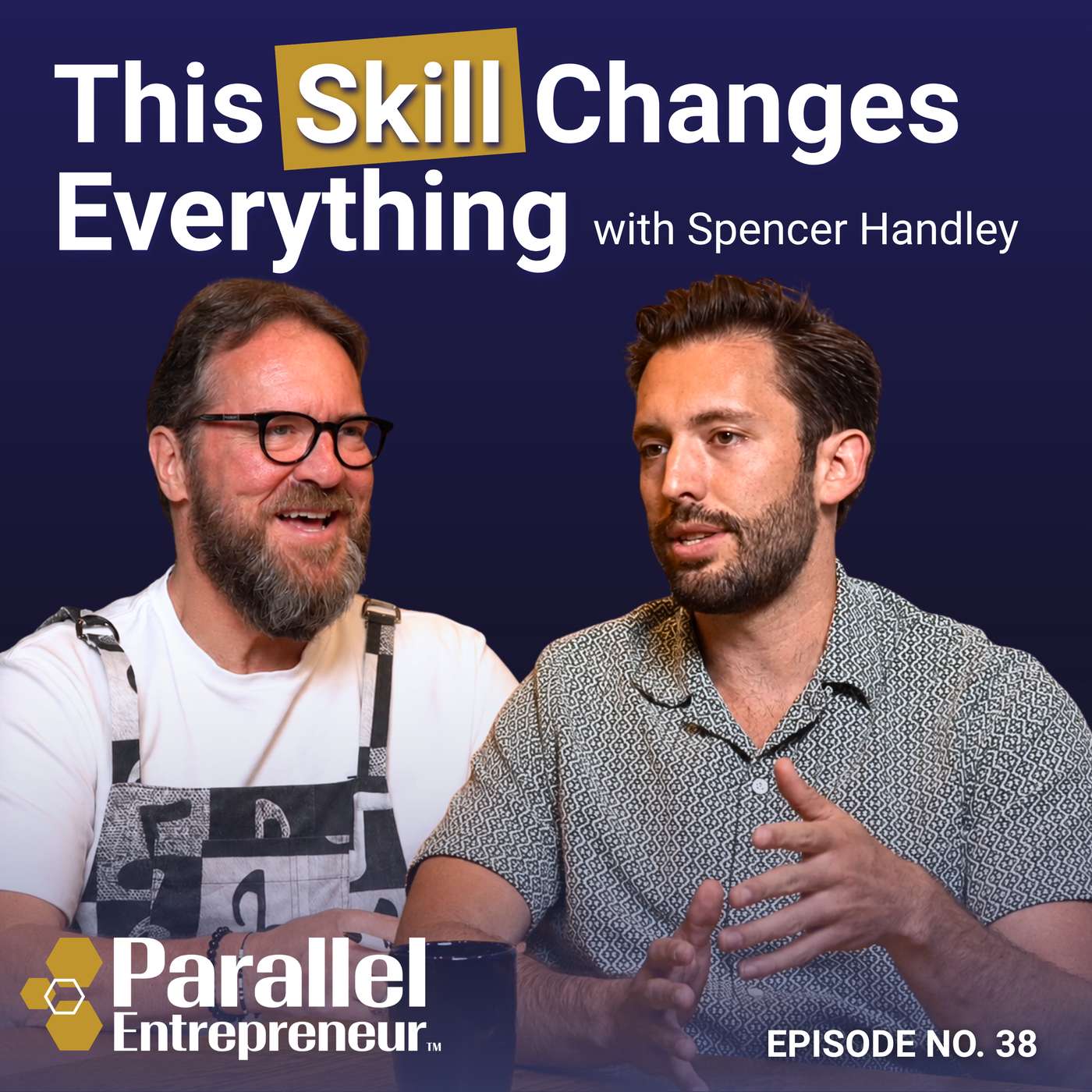
Episode 38 · Spencer Handley

The AI Skill Every Working Adult Needs to Learn | Spencer Handley

Parallel Entrepreneur with Mark Cleveland · Episode 38

0:00 / 1:20:01
The AI Skill Every Working Adult Needs to Learn | Spencer Handley
0:00 / 1:20:01

Episode notes

What happens when a musician, software engineer, educator, and entrepreneur all show up in the same person?

In this episode of The Parallel Entrepreneur, Mark Cleveland sits down with Spencer Handley, Founder and CEO of Sonora, to explore a career built on curiosity, learning, and challenging conventional thinking.

Spencer shares the story behind Sonora's growth from a guitar education company into a modern learning institution that has helped nearly 6,000 students—including multiple Grammy winners—reach new levels of mastery. He also discusses the recent national attention surrounding Sonora's AI transformation, what actually happened behind the headlines, and why he believes learning to work with AI may become one of the most important skills of the next decade.

Along the way, the conversation explores accelerated learning, entrepreneurship, creativity, the future of work, building companies around personal passion, and what world-class performers can teach all of us about continuous growth.

In this episode

• Why curiosity has been the common thread throughout Spencer's career
• The two-year guitar plateau that ultimately led to founding Sonora
• How Sonora has helped thousands of musicians accelerate their learning
• Lessons from Grammy-winning artists and elite performers
• What really happened when Sonora rebuilt its technology stack
• The opportunities and risks AI presents for founders and professionals
• Why Spencer believes learning how to manage AI agents is becoming a critical skill
• The future of education, work, and human creativity

Whether you're a founder, creator, educator, musician, or someone navigating the rapid changes happening in business and technology, this conversation offers practical insights and a thoughtful perspective on what comes next.

Links & Resources

Join the Parallel Entrepreneur Network.

The Time article: The Small Businesses Already Replacing Workers With AI

Spencer's response: AI Didn't Replace Our Workers. It Replaced Our SaaS Stack.

Connect with Spencer: Sonora Music Education · Spencer Handley's website · Pioneer Species · Playback Sessions on YouTube · Spencer Handley on Instagram · Follow Spencer on LinkedIn

Sonic Sphere: sonic-sphere.com

Connie Yang: Connie Yang on Instagram · Connie Yang's portfolio

About the Host

Mark Cleveland is an entrepreneur, investor, and advisor who works at the intersection of multiple ventures. As the voice behind The Parallel Entrepreneur, he explores how founders build aligned businesses, strong teams, and sustainable momentum, without forcing themselves into a single path.
Follow Mark on LinkedIn

Key Moments
00:00 Introduction & Spencer's bold prediction about AI
00:43 Welcome to The Parallel Entrepreneur
01:17 The common thread: curiosity and learning
02:00 What is Sonora?
03:00 Why Grammy winners still take lessons
06:38 Studying music at UCLA and the search for mastery
07:38 The "intermediate plateau" that changed everything
10:20 The teacher who transformed Spencer's playing
12:05 How Sonora was born
14:05 The science of learning and creating momentum
17:15 Teaching through transformation, not information
19:45 Building community around mastery
23:00 Creative projects, side ventures, and parallel entrepreneurship
27:00 Why Spencer learned to code
30:00 Using software to solve your own problems
33:30 The entrepreneurial advantage of technical skills
36:15 AI, agents, and the future of work
44:25 The TIME Magazine story
47:40 What really happened inside Sonora's AI transformation
50:30 Why the middle-management layer may disappear
52:00 The human work AI can't replace
55:10 Rebuilding an entire SaaS stack
58:40 Pioneer Species and teaching AI skills
01:01:10 Flow, energy, and avoiding burnout
01:05:20 How Spencer decides what to build next
01:08:50 Managing multiple ventures without losing focus
01:12:40 Lessons from world-class musicians
01:15:20 What Spencer has changed his mind about
01:17:30 The future of learning, AI, and human potential
01:19:10 Final thoughts

Related conversations

Stop Doing Tasks AI Can Handle — Shauna Sprague on automating the mundane and working at the top of your skill set
Why AI Strategy Fails Before It Starts — Jon Hilton on moving AI from pilots to production
Why Today's Leadership Playbook Breaks in the Age of AI — Amalia Goodwin on leading through AI transformation

Subscribe for more conversations with founders, investors, operators, and creators building extraordinary lives across multiple ventures.

#ParallelEntrepreneur #MarkCleveland #SpencerHandley #Sonora #ArtificialIntelligence #Entrepreneurship #FounderStories #CreatorEconomy #FutureOfWork #BusinessPodcast

Chapters

  1. Introduction & Spencer's bold prediction about AI
  2. Welcome to The Parallel Entrepreneur
  3. The common thread: curiosity and learning
  4. What is Sonora?
  5. Why Grammy winners still take lessons
  6. Studying music at UCLA and the search for mastery
  7. The "intermediate plateau" that changed everything
  8. The teacher who transformed Spencer's playing
  9. How Sonora was born
  10. The science of learning and creating momentum
  11. Teaching through transformation, not information
  12. Building community around mastery
  13. Creative projects, side ventures, and parallel entrepreneurship
  14. Why Spencer learned to code
  15. Using software to solve your own problems
  16. The entrepreneurial advantage of technical skills
  17. AI, agents, and the future of work
  18. The TIME Magazine story
  19. What really happened inside Sonora's AI transformation
  20. Why the middle-management layer may disappear
  21. The human work AI can't replace
  22. Rebuilding an entire SaaS stack
  23. Pioneer Species and teaching AI skills
  24. Flow, energy, and avoiding burnout
  25. How Spencer decides what to build next
  26. Managing multiple ventures without losing focus
  27. Lessons from world-class musicians
  28. What Spencer has changed his mind about
  29. The future of learning, AI, and human potential
  30. Final thoughts

Full transcript

and I have come to adopt a pretty strong belief that that learning how to not just build software with these agents but learning how to manage agents both personal and professional use cases is the most essential skill to learn for every working adult in the world instantaneously Claude knows everything about every aspect of my business and so in a in a way it's like the most incredible board member or advisor the middle manager layer is is gonna be gone I think it's gonna be gone and um we've had almost 6,000 students go through the program and we just had our seventh student win a Grammy Spencer welcome to the Parallel Entrepreneur

so the Parallel Entrepreneur is all about celebrating the messy beautiful art of doing more than one thing at the same time and investing your passions where they belong where they wanna go and bringing things to life and it manifested for me in owning owning more than one company at the same time yeah that's parallel entrepreneurship and uh for you we're gonna have a great great conversation exploring your background and when I when I look at your career from music to software to education and to AI it feels like there isn't a common thread running through it until you until you think well hey Spencer what's the common thread I think that the

I think that the common thread is curiosity and learning I think that that's the fundamental through line that that everything that I've ever started um it is rooted in I'm just naturally curious and I I want to figure things out and as I figure things out I think the natural next step for people is to is to then pass that along and teach it to people and and you can build businesses around that teaching process and yeah I think being curious unlocks all sorts of opportunity to build and create value in the world so you're the CEO of a company called Sonora yeah and the mission is to educate and bring uh

the power of the student forward right would you talk talk to us about what Sonora is yeah we're a modern music institution so we've taken what most people would do in an undergraduate degree in four years and condensed it down to something that a student can complete in six to 12 months of focus study we think about it through this lens of accelerated learning so taking principles from the neuroscience of learning and adapting it to music and allowing the student to progress through um this curriculum really rapidly we believe in hybrid learning which is kind of a combination of software based learning but then also one on one direct mentorship

and we've been in operation for the last almost eight years seven and a half years right now and we've had almost 6,000 students go through the program and we just had our seventh student win a Grammy seven Grammy Awards yeah that's that's spectacular yeah and you have Grammy Award winning teachers as well yeah yeah our our faculty they've all taught at top institutions and played with some of the best artists in the world and yeah so we've we've made a really solid team of people who really know how to do this stuff and and as far as I'm aware and I know the space pretty well we're the most forward thinking music institution on the internet and we're not for everyone

but for people who kind of want this like serious path and are aiming to attain fluency and be really creatively expressive on their instrument we're we're the best game in town creatively expressive I like that um the student experience at Sonora is what student experience yeah um it's a combination of a few different things so there's software my background's in in software engineering um and so there's software that models the student's memory helps them understand you know what they should be learning next what they're about to forget based on their own forgetting curve so we power space repetition then there's one on one direct mentorship that happens on a daily basis

and there's group classes that people attend we have a uh we have a curriculum that we run them through which is essentially equivalent to what a student would learn in an undergraduate education so it covers all the same materials you'd learn at if you went to you know guitar or you were a guitar major at Berklee College of music or something like this um and so yeah we kind of try and hit it from all angles it's remote so you don't study in person but we find that for a lot of the fun fundamental mechanics of the instrument it's actually learning online has a lot of advantages because software can kind of harness the person into a certain path it can

it can handle these things like spaced repetition the delivery vehicle is more easily consumed um and uh it's just more like or organized better better pacing so it's really fun yeah in the comment section there's gonna be a lot of resources that people are gonna wanna click through and learn more but tell us what a Sonic Sphere is and why did it capture your attention yeah so the Sonic Sphere is a project that was developed sort of a co living castle just outside of Paris France that I spent a bunch of time at it was initially developed by a man named Ed Cook who is like a memory champion really interesting amazing person and uh he wanted to have a spherical concert hall

where he could experience the wonders of music uh spatially and basically sit in he wanted the vision was I wanna sit in a net and have speakers coming from all directions from below me above me from all sides uh and then I want spatial audio and just be able to bask in the glory of it and um there have been uh 11 iterations of this sphere and they've gotten progressively larger each time the first one was the size of a of a bedroom uh and then you know sort of got progressively larger there's a sphere still at in France that holds about 30 people inside of it in a giant net um and then we brought one to Burning Man it was a fairly large sphere

and then the biggest one that was created was um it was stored in in the shed at in Manhattan which is the largest indoor one of the largest indoor art exhibition spaces in Manhattan and it was a a megasphere that holds somewhere around like 200 people inside of it huge massive sphere in a massive production and um you know millions of dollars went into the sphere and and we had some amazing artists play play in it and um and I built a bunch of music experiences for the sphere and have been um yeah she's kind of like involved as a as a creative in that project for the last couple years so you studied music at UCLA yeah at the musicology practice there uh

and for thousands of hours like most musicians you just kept on until you owned the instrument at some level and then I think after like two decades of traditional music approach you found yourself stuck yeah what did that feel like and how did you get unstuck yeah I think there are uh with any skill so I'll speak more broadly but this happens in music but also happens in any other like skill acquisition path be at languages or learning about business or learning about any any skill there's massive gains from 0 to 60% capability um you just make massive leaps and strides it's the most exciting time of of of learning a skill is is the beginning stages um

it can be frustrating but it's also just like every day your skill set is changing um so uh then you get to the intermediate what I call the intermediate plateau where the the incremental gains just um they just slow down a lot and and and it it can be a year of like basically no progress even though you're still putting in work and like working on the craft it can feel like you're basically spinning your wheels and um this exists in yeah most most domains within the sphere of guitar um everyone gets stuck at this level where they learn their open chords their bar chords pentatonic scale and then they sort of most 90% of guitar players out there

just kind of stop there that's the intermediate plateau you can kind of sound okay to the you can be good at a party yeah right campfire guitar player kind of thing beyond that there's obviously many many many levels to the game and there are true masters of this craft that are stratospheric in their in their capability and their their ability to translate the ideas in their head immediately to the instrument seamlessly with you know with with no impedance and um and a lot of that has to do with kind of circling back to the fundamentals so it's it's sort of like um people learning to cook is a good analogy it's like you can go you know use recipes and that that'll get you

you know pretty far you can sort of like fake being a chef so to speak but if you want to actually become a great chef you have to learn the fundamentals you have to actually learn the principles of cooking and and combining ingredients and the chemistry of of you know what it takes to to actually be inventive and so the same is true in music in order to break past the intermediate plateau fundamental principles so scales diads triads arpeggios seventh chords inversions like how does the actual instrument map and then how do you then apply that fundamental architecture to all different styles because all world music styles and I've spent um as maybe we'll dig into spent five years yeah

just nomadic traveling from country to country every three months studying so many different types of world music but the common thread through that is that the principles of music are the same the only difference is the rhythm changes and the idiomatic phrasing change changes so like the way that they express melody changes regionally but the but the principles of how how harmony functions is relatively the same with a few exceptions that tend to happen in East Asia so you found yourself stuck yeah you described what that felt like you were just not making progress and that it's a common experience the most the most common experience maybe and then you

a lot of people struggle with getting out of that place yeah that it's not necessarily common that people get unstuck right they're stuck yeah how did you get unstuck I just great teacher I found a great teacher this woman named Ayla Cantor um who was yeah just had a really clear path and good pedagogy and and sort of helped me move through that path really smoothly and then at the time I was working as a software engineer uh I was there was a position called a product engineering leader at Patreon so I was holding down that role helping to build the growth team and um on the side I would work on little software projects to help help me with my hobbies

and so I built some software around her path that was basically the first version of the Sonora software um and it was a spaced repetition app that you could plug exercises into and it would kind of develop practice plans for you and tell you what to do each day and and then keep track of the things that were likely to like leave my memory and then you know sort of resurface them and it would just send me emails like here's your here's your practice plan for today and um and then I would sort of check things off in a little Google form and then that would be the that was the interaction um and it it worked like it you know within a matter of about a year of study with her

I broke through that plateau and of course there are more plateaus beyond the intermediate plateau that that happened and I'm on one right now that's that's gonna last a few years cause the incremental gains are just so small it's more about repertoire but um but there's the biggest the biggest one is this intermediate plateau cause on the on on the other side of the intermediate plateau is a profound level of expressiveness where you can really um be dynamic in any musical setting before that it's it's very clunky so uh most people need to get get over this hump uh and so anyway we went uh from from that initial sort of study with her and building the software

about a year after that um friends started basically asking for hey can I do that thing that you did with the software and blah blah blah and it was just sort of started as like a side project just for fun and then it you know those friends started telling other friends and then we sort of ran out of capacity to help students um so I had to hire a a teacher and I um I I happen to be taking some some extra lessons from this guy on Instagram who's kind of an influencer and I was like hey do you wanna teach some extra students I got I got students coming through this thing and we're kind of developing this this like little pet project and then that turned into more students

and then it turned into even more students and the pandemic happened and then we had all these amazing musicians uh on staff who needed consistent work so we had to build like a marketing function like a proper marketing function and and like an admissions function and and then fast forward to now and now it's you know a pretty large team and um and yeah it was sort of like an accidental business yeah but but but coming from the uh and I think I think this is also like a a thread that feels important which is like the a lot of people think like I wanna start a business what business should I start um but I think actually the the world sort of invites a business out of you

when the time is right it's like the same is true with pioneer species like I didn't I'm not intending to start a business here but enough friends at this event that we that we uh that we did over the New Year enough friends were like teach me about everything you're doing with AI and I was like OK cool and I organize it and now it's now it's like a company and then it requires no marketing cause those friends tell more friends and like every cohort is filling with like friends basically or friends of friends and so the world recognizes you as a person who knows a thing about a thing and then they want to learn from you and then suddenly you're doing that thing

and I I like that most successful businesses or or entrepreneurs solve a problem that they have that they understand yeah and that happens to solve problems for other people and I think this sort of rote approach to I'm gonna do this and my my Tam is this and right you know it's it it's it's an exercise that is good to have familiarity with but it is not the heart and soul it's not what a culture is built on right a culture is built on your passion for music and I think awesome also teaching like what have you Learned about how humans learn that has impacted your business and your your life your lived experience yeah so many things I think that obviously there's a bunch of there

there are a bunch of principles and cool techniques for sequencing content and making sure that pads are digestible and pedagogy is strong um that's a whole field of study that's fascinating and and and um and useful but I think the biggest thing that prevents most people from learning complex skills like music or business or engineering is um is just the motivation wheel so how do you actually get the motivation wheel running um so that there's enough of a carrot with each incremental step that's pulling you to the next step right how do you how do you basically embed wins into the process so that while you're learning this very challenging thing

that forces you to confront all sorts of limiting beliefs and and uh difficulty in yourself how do you make it so that along with that adversity you're also getting little treats of like wins basically so I think I think good educators have ways of embedding those wins uh in in the learning path um and yeah I think I think that's I think that's one of the main things I call those little victories yeah I like to open up a meeting with hey what's your little victory and everybody has to find one you gotta come to the meeting with a little victory even if you you know most of us think that a victory has to be big and in fact they're just um stringing together a whole bunch of small progress

right yeah yeah I um was enchanted with the sphere we're gonna talk about that again in a minute but yeah um and because of our conversation you'd like change how I thought about music how I thought about experiencing music and then you invited me to on Poco de planning which yeah um I'm gonna throw this out as a softball first of all you could describe what it is but I'm gonna I'm gonna talk a little bit about how it was to experience it yeah great and uh I'm so curious and this is something that you've done a couple of years in a row you invited my wife Jenny and I and a number of our common friends and then about 40 45 people that I did not know yeah

um um creatives entrepreneurs from all over the world and we went to Mexico City for a 2025 review and a 2026 visioning exercise that lasted a week yeah and I I think it's notable to start with most of us set goals aren't committed to them we we might be clear enough to set intentions and and that's better yeah and then we put things in motion but we didn't actually give it a week or in this case two weeks total um to really reflect and simmer and sort through how would I be motivated and how would how could I marinate on this idea

and then get committed to it yeah so that was that was a piece of my experience why did you create um Pocahontas planning and what was your experience there and what do you want people to know about it um well I love I love organizing my life and thinking about thinking about what it would look like to to paint a vision for my ideal future and think about my contribution in the world and and I like to have structure around it and I've been doing it since I was in my very early 20s like thinking about okay life kind of has these like 5 to 7 categories what are my like main objectives for some period of time in those categories and how can I how can I kind of be intentional about

you know choosing my future rather than just like being being subject to the whims of the world or other people's intentions for my life and um there for a few years I uh was in this accountability group called the team Horrific Accountability Buddies uh which was Accountability Buddies Accountability Buddies yep and uh and so we would um you know we would meet every single week and hold each other accountable and then we would do these little retreats where we'd like fly to Thailand and do these sort of intensive um uh annual planning and reflection things and so I loved the model and I just kind of continued doing it that group phased out um

but a couple of years ago oh and then I've also attended other people's like New Year's planning thing so I you know I vibe with people who are like into this intentionality around around annual planning and so a couple years ago my friend uh my friends Marcus and Carter uh were like hey we're thinking about gathering another group and I was like awesome let me get involved and and we organized that a couple years ago uh for a smaller group 12 people and then this this last year um you know sort of organized a larger group and and took everyone to Mexico City and uh and then thought a lot about how to structure an event like that like how do you

how do you actually get 40 people on the same page with different different intentions different visions to think about the last year think about you know a 10 year vision for themselves what what's their what's their long term outcome that they're aiming towards and then how do they get sort of tactical about um the next the next year and the next quarter and and then um and then also there's just so much cross pollination that happens like in these groups where you know obviously the folks that were at this event are just so so inspiring on so many different levels there were people who were very left brain very right brain uh a mix of both and

and so when you get everyone into uh one place and they they you know some of the most magical moments happen outside of the programming and and uh just kind of seeing how other people operate in the world and what's inspiring to them and and then um yeah it's just it's a really powerful container and I also think it's it's a nice heartbeat for a community and I'm I really especially as I get older the value of like creating cohesive community over long periods of time is really important to me um so it's and it's I think it's such a vulnerable space to be in that it creates these really deep bonds with with the whole crew because you really get to understand who's this person

at a fundamental level what are their values what's their vision and uh you get to learn from them and then you know you really get to form these relationships that last forever you know yeah you're building community intentionally right um the music community the musicians are a community and and and here you've got um people who are planning a life pivot or uh extension it was it was all the above yeah and and the community was beautiful um I Learned so much I uh I my wife Jenny and I actually started this process with um well we're going to Mexico City that'll be great yeah and we tried to leave our expectations behind so that we could just experience yeah

the process and um you talked about left brain right brain some of those structures like I really gravitate towards Spencer's organizational principles for getting shit done yeah you know yeah and uh I also really appreciated people being vulnerable about their fears and yeah uh you know what's holding them back and talking about what's holding you back yeah um this this experience LED Jenny and I to commit to building a new company together and the motivation was we looked in our relationship and found that we were happiest we were extremely successful feeling when we were collaborating yeah

and it didn't really matter what we were collaborating on yeah so we said well how can we collaborate on bringing something creative to life yeah and so I have this background in textiles for swiftwick um she has this overall that everybody says is awesome and she wears it you know it's the only pair of overalls in her wardrobe and she's wearing it and and even the people at um Poco de planning were um reinforcing and supporting like that's really cool where did you get that and the answer is you can't get that anywhere right so we decided to create happy overall my friend Brandon shared a piece of advice recently dress so that if someone dressed up as you for a costume party

everyone would know it was you now that's not entirely about clothing that's about identity about showing up fully my wife Jenny and I are leaning in on this concept both in our personal lives and now in a little startup we call happy overall we're making overalls each one is made to order as a wearable canvas for art overalls that are comfortable durable and expressive we're sourcing soft 100% cotton we're partnering with designers and with local seamstresses who love the artistry of a well crafted piece of clothing we're launching in summer of 26 so check out happy overall.com to see pics and see if anything resonates with you

fully you and it'll happen every time you reach for them if you want to be part of the first run join our waitlist at happy overall.com and there was this conversion so I'm speaking as like an experiencer of that where you got to commit yeah I think that there's I love that question I think I love seeing someone who's like I have an inkling that this idea is gonna feel really good for me to execute on but I've got all of these like um doubts about is it is it gonna be a good idea is it gonna work am I the right person to do this thing um is it is it just like a pie in the sky like too ambitious blah blah blah blah

um I don't think you suffer from that I think that you you know that you can execute but a lot of people um on on at all levels I have this like doubting voice in the back of their head that prevents them from taking a step like that and it's cool to surround surround yourself in community where everyone sort of like uh it actually is quite possible it's quite doable and here's how you would do it in fact like you've got demand right here like you got a bunch of people who want the thing um do it and then there's a light switch that turns on for people of like oh actually if I if I just commit to doing these things and I see the first three steps

I can do that that's realistic and it becomes much more plausible and then suddenly action comes out of that I think about last year my friend Connie uh she was she was at the the the New Year's planning event and she was like I really want to I'm really good with words and I'm really you know I have this artistic vision for this thing where I interview people and then I paint their bodies with some of the words that they have said in this interview that's that's really meaningful and take photos but I have no idea how to do photography or like it just seems like it like I there's no way I'm gonna do this thing and literally within a month of

of the the planning event she had done it she had organized 12 shoots 12 interviews and 12 shoots she had this whole art gallery piece essentially and then she was presenting in Mexico City ironically at Zona Maco by February uh you know a month after she had set this intention with no idea how she was gonna accomplish it she was like an artist a gallery to artist a month later and it's just the power of this intention and and also the galvanizing of the people around you who are like you know in the room we're like how could you do it well you need some lights you need someone to take the photos you need a model to to interview and and paint

and there were people in the room who were like I've got lights I've got a camera I'll be your model you know it was just like it all came together and next week they had a shoot and then suddenly it was like a project right um it's just really cool to see things manifest so so quickly and easily and and I think community does a lot of that right yeah Parallel Entrepreneur started as a an exploration of my seemingly inability to focus on any one thing for a 25 year career and get a watch yeah you know um I I know a lot of entrepreneurs who focus on one thing for a long time and and we read a lot of books that say you know 80 20 rule do one thing

sure and I I I just don't think that is resonates with me that's all yeah it's not the model for everybody no yeah I I feel like there's some wisdom in this parallel entrepreneurship and there's also some challenges and you you you speak about it in your writings as generalism yeah um talk talk to me about that yeah generalism is basically this it's a perspective that most domains have have overlap I mean we we know about this from like the Renaissance era like there's such a thing as like the Renaissance person and it's it's this it's this idea that if you learn a lot of things across a lot of domains they have applicability in adjacent domains so

um uh a really great example one of my one of my favorite examples who I I recently had on my podcast Jack Conty um is an amazing CEO of patron and um and also an amazing band leader and he's really good at running this company which also makes him very good at running the band and there's just like this immediate obvious crossover of you know you know study in this other domain turns out it makes you really really um capable in this other domain and so instead of feeling like having a lot of interest and being uh you know quote unquote scattered is a bad thing it actually is uh following that curiosity will have all of these downstream compounding effects because

of the way that subject matters tend to be complementary which is Charlie Munger was a lot had had a lot of ideas around this or has a lot of ideas around this where he's got these like the hundred mental models idea where if you learn the like primary mental models from all of the primary disciplines biology physics you know statistics all of these things they although they exist within these specific domains they are broadly applicable to all things in life if you learn the 100 most common mental models you can be really successful in life as long as you internalize them because they are these generalizable tools for for life and I I feel that way uh yeah

so most people talk themselves out you were speaking about to to this earlier most people talk themselves out of the business idea yeah or it doesn't mean you're starting a business it could just be a creative project but for one reason or another we talk ourselves out yeah and when we got in community we were reinforcing plus the right brain the right brain and the left brain person were each helping each other right through these breakout sessions yeah and I think a superpower for a parallel entrepreneur is um not believing that you start the answer to the question with no I can't right exactly yeah the answer to the question is let's find out

you know yeah I also think that I also think that there is something about generalism that creates agency and I think that entrepreneurship is all about agency I see a problem in the world I want to fix it how quickly can I go from from a desire to fix the problem to a solution and it's very hard to do that if you don't have a pretty broad array of skill sets and so for me for instance I I grew up a computer nerd so I I loved making websites and coding since I was a kid um and whenever I see a problem I I very quickly moved to okay well how can I use software to solve this for myself uh or for other people and so that skill set strapped on sort of has this

has this immediate agency component which is not that I'm gonna go monetize my skill as an engineer but I can use this skill to build a solution that I'm looking for and then as you build companies as you know you end up having to strap on all these other skills cause there's no one else there with you until you've got the money for it yeah so you learn accounting you learn how to manage uh a team you learn how to run a good sales process you run you learn how to run Facebook ads if that's what you're doing you learn how fulfillment works how to how to actually manage high quality uh service for for your customers and and so you you just have to like bolt these things on

and then you realize that all of those skills though they are disparate skills and and require different parts of your brain um they are generalizable in and of themselves and you can take those same components and then apply them to every possible type of business and you turns out you everything in life is kind of a business so you can then do basically anything yeah basically anything you studied Chinese right and then you've become fascinated by the process of language learning you even talk about a guitar as a language yeah um how does the uh how does language acquisition factor into these skill sets that you're talking about they're they're identical

especially kinesthetic skills so I I kind of bifurcate learning into maybe this is maybe it's it's there's there's more gradient to to this but you can kind of think of things as like cognitive skills and kinesthetic skills like embodied skills like languages and and instruments versus cognitive skills which are things like math and science now obviously kinesthetic skills have a cognitive component but but um they all have a very similar learning mechanic which is you have a set of information that you need to memorize um and then you need to figure out how to uh turn that memorize stuff into into immediacy so like uh make the the information intuitive

uh uh quickly so it's so for for for instance uh it's one thing to learn a scale I can sit down and teach you the G major scale on guitar and you'll sort of learn it wrote it'll take a couple of days to get in your hands and then um then how do we take that skill and and and turn it into something that you can actually express with it's a very different learning mechanic there's a different step in the phase in the process to to go from initial memorization to to implementation the same is true in languages I can teach you a bunch of vocab and and throw it at you but um it's not that useful if you don't know you know how to structure sentences

and then how to pull those words um into your working memory very quickly and and uh and then use it in conversation and know which version of this word to use in a certain conversation to imply the right um uh feeling to the listener but yeah a lot of the learning mechanics are the same spaced repetition being one of the most useful ones but also sequencing like how to how to deconstruct skills isolate the most high frequency um high value vocabulary grammar techniques and then sequence it so that the next thing you're learning is built on the last thing and not you're not sort of like randomly taking things from the tree and trying to like digest it because the brain doesn't

have anything to associate it with yeah I love the way that you self program and as a CEO you're the leader trying to train and develop a culture trying to train and develop a business trying to make sure that customers are received in a way that is consistent with your business mission vision values and I I wonder I don't I don't think we all think enough about training about the outcome that we're looking for it seems to seems to apply if I wanna my outcome is to I wanna be a virtuoso yeah um then I can embody that but my outcome might be I just wanna be a really great customer service manager or a really great um problem solver in a business

and these things that you're describing are the building blocks and mechanics of teaching people how to learn yeah the fundamental principle I think with a lot of this stuff is um this you know this theory of constraints idea um like in a in a in a business if we want to grow we always have to direct our attention to the the biggest constraint so not like uh what is someone else telling me I should do with my business but actually look at the business understand what the throughput metrics are for the business and where the biggest constraint is and then try and understand you know what's causing that constraint and then come up with some hypotheses for how we might

unlock that constraint and then test it see how it works and then if it if it does work then you know the constraint is gone we focus on the next constraint the same is true in in learning so with music you run into constraints by putting yourself in uncomfortable circumstances so I'm trying to learn bluegrass I'm gonna go to a bluegrass jam I'm gonna get someone's gonna point at me and say go take a solo and I'm gonna take a quick solo and I'm gonna feel really comfortable over the G chord but once I get to C I don't know what to do anymore I don't have any vocabulary there so okay my constraint is I need more C shape vocabulary so that when I get to the C chord

I know what to do I'm gonna go home and I'm gonna learn 10 10 licks in C and then I'm gonna go back to the jam and see did those did those licks come out did I internalize them enough that they became intuitive so I could use them in the moment and uh and then if they did then I move on to the next constraint so learning learning skills learning languages uh running businesses it's all it's all sort of like fundamentally about attuning attention to the areas of of most significant constraint and then running experiments or devising devising um little environments to fix those constraints yeah I like this little environments um sometimes we try to boil the ocean

instead of just getting the teapot going yeah and I Learned a lot about AI from you and a number of other genius people at at the the at the planning session in Mexico City and that then became of course we were all like hey Spencer teach us yeah um that became pioneer species yeah and I think I'm one of your first uh underperforming graduates haha you did great haha you did great I had a great time doing it and what we the experience was Spencer's gonna take us through AI uh and I've I've studied AI I've had people working for me who were talking about AI but there was always like

a missing block of vocabulary or a missing reference point or something about my learning that made me less comfortable yeah making decisions or directing other people who are talented and expert in this area and your approach was all the things that we've been talking about you laid it out in such a way that I got super excited and there was this moment where I was I was really taking it in and then there was this moment where I was lost and then there was this moment where I started pulling all nighters doing vibe coding you know it was awesome yeah um tell us tell us what Pioneer Species is all about and how that how that's playing out yeah

well I uh so in November of 25 a new model came out called Opus 4.5 developed by anthropic and uh it it really unlocked it was the big unlock for for agentic coding and development before that it was pretty bad like you you would try and vibe code and it would just basically just spit out broken code and it was not useful but in November end of November early December right before poker to planning it uh it got really good and so um uh I I've been tracking obviously the ecosystem really closely and experimenting with all the tools and um and then in the month of December rewrote a bunch of software for my company and then also like built an app for Poco to planning

and I was like okay we're actually here at this point where you know it's possible to build like pretty complex software using these models and and um and so um what I came to realize over the first quarter and what you know many many people obviously are coming to realize now too is yeah is um we're moving into a very different landscape in terms of the way that we uh work in the world and the way for operators and company owners uh everything is is is shifting um about how we should think about hiring and and um growing our teams the types of skill sets that we should be looking for and I have come to adopt a pretty strong belief that that learning how to

not just build software with these agents but learning how to manage agents for both personal and professional in both personal and professional use cases is the most essential skill to learn for every working adult in the world no matter what you're doing whether you're uh in customer success or you're on fulfillment or you're doing marketing or you're an engineer or you're um you know anywhere within an organization or you're a solo entrepreneur building things uh every single thing that you can do with a computer uh agents can now do if you design the right environment for it so uh it's it's this amazing lever where you know the the nature of my work personally

six months ago versus today is fundamentally different I I start my day and I'm basically spinning up like 15 20 30 agents to work on different tasks and then I'm I'm spending much more time uh Q a and useful and and then like sort of keeping the plates spinning and and and I'm also you know Pioneer Species was basically designed to upskill my friends who some of some of whom are are technical and some of whom are are not technical and uh and also my team so I built it to put my team through it so now you know a bunch of folks on my team are building software tools that were never technical from the most junior to the most senior people on the team

everyone now can write code and like build things for the company uh within Sonora we rewrote the entire tech stack for every piece of software we previously paid for so it was like you know everything from our CRM to our calendar scheduling tools to our contract software to a bunch of software that we that didn't exist before for different processes within the company that we just invented from scratch but built very quickly because you can now um and uh and that was really great one because we saved like a quarter million dollars a year on sass expenses um and two because once everything is is centralized and all the data lives in one place and

and and you own all the hooks and you've customized the software to exactly what you need agents can now operate in that domain a lot more fluidly than they could with bespoke software from third party providers where you don't own all the API endpoints and so there's a real advantage to having everything sort of centralized in terms of speed um I can answer questions about my company that I couldn't answer before instantaneously Claude knows everything about every aspect of my business and so in a way it's like the most incredible board member or advisor it it knows second to second exactly what's going on in the business what's what needs improvement

what's what's going well what's what's you know what it gives me preview into things that previously would have been impossible or would have required an immense number of managers who are Q a everything meticulously and then reporting that back up to me which is an incredible cost structure right um it also allows the ICS to be more capable so instead of having someone a marketing person write an email campaign put the subject line uh figure out who to send it to I can just say write me a you know marketing campaign for this thing you already have the cloud skills for how we write things and how we think about it you you know everything about the website and everything

it's gonna go make a landing page it's gonna write the email campaign it's gonna plug it into uh the email delivery software it's gonna figure out who it should send it to and who it shouldn't send it to and it's gonna just say cool I did everything everything that you know previously would have been you know a month long project with with a lot of people involved and it's just gonna say take a look at it make sure it looks good and if there's anything wrong with it I fix the problem with it but then I also fix the the cloud skill I fix the context that created the problem so that it never happens again and um you know you can kind of see how this

how this downstream creates so much more leverage in terms of use usage of time and and the quality improvements are amazing and and so yeah now we just have like you know a ton of agents that that are working within the company enabling everyone to move a lot faster and I just think it's fundamentally one of the most important skills for people to learn so I'm teaching it now it's mostly a pet project for fun but we've done two cohorts now uh a lot of my friends have done it they've recommended more friends we do like 80 people in each cohort uh my parents did it uh yeah so my daughter who's in the second cohort yeah with yeah my son in law yeah

they both got different things out of it she reported that she was looking to solve problems and prepare for a community development project yeah where she's gonna take a leadership role and um as soon as she's ready to take it she wants to hit the ground running so she's really building cloud skills yeah to be ready for this new volunteer chairmanship role that she's got and her husband was saying okay well I now know how to I t reports to me I now know how to see this um smorgasbord of opportunity and to make better decisions in collaboration with the people that you're charging to go do it right yeah so the you you I feel like super fortunate

because I got to know you and got to spend all this time with you and learn from you and the rest of the world just kind of Learned a little bit of something about you from a time magazine article that was just published what what was how did that come about what was the outcome and and yeah what can we learn from it yeah um I met a guy at a party um a few months ago who that's what you said about me I met Mark at a party yeah yeah right exactly yeah I met a guy at a party and I didn't know at the time but he was a reporter for time magazine and we were talking about this like agent transformation thing and he was writing a piece his piece was primarily about um

displacement within small and medium sized businesses and so he was he was looking for subjects for this this piece and um and and so we ended up being sort of like the main company that he wrote about which was like here's how this company went went in rewrote all their software and our team scaled down a little bit because there were functions within the company that were either existed because the role was to maintain the existing SAS software or um you know we had like an outbound um setter team that uh we we scaled back because a lot of there were a lot of agents kind of doing that work so there was a narrative there around displacement my feeling around it when it was

it was cool to have this time article written my feeling is uh it's less about the displacement narrative like in my view we're still gonna be hiring the team is growing like we're gonna uh there there's still a need for humans in this world but and the business is growing and you're doing things more efficiently and you can think of a question and get the answer instead of saying memo right so things are more efficient and there's an UPS there's a the more empowering narrative here is is around upskilling so fundamentally as I said I think every single person who is a working individual in the world needs this skill set and so I started with my own teams

like everyone needs to learn this skill like doesn't matter what you're doing in the company you need to be really good with Claud um or or Codex or whatever model is is good they're all fundamentally the same um and so um how do we basically take everyone who's in the organization and upskill them to a point where they're good at managing agents and then the overall output of the company gets higher and um and so yeah the article spoke to that and and uh and it was yeah it was cool and then I wrote a a another piece that sort of a supplementary piece that added more color to exactly what our process was there like what we what we replaced and why what the implications were

what it enabled us to do and how it accelerated that I put it on my blog which maybe you can link to in the yeah I I thought that the blog was spectacular and I particularly appreciate people who can write well yeah and thanks I like this idea that you know for time magazine it's framed in one way yeah and it's impressive and but the reality is this is the the many benefits I think there's so much fear yeah we can we got we got a choice brother we can choose the path of love or we can choose the path of fear and we make that decision every second right and I loved how you pushed through the hype and yeah got deeper into the benefits and where everybody's winning yeah

I think one of the things we've talked about is um and I I do mergers and acquisitions and I work with entrepreneurs who are taking their company to market yeah and as a sell side advisor there are some common things that I see happen and most of the time it's they're not prepared yeah they think they are yeah and they want to get prepared so then there's this period of time in which you have to spin up and be ready and we'll create this thing called a data room I mean yeah okay what I love about my all my conversations with you is you have a virtual data room right now yeah it's 24 hours a day working for you yeah let's let's dive into that a little bit yeah

there's a benefit 75% of CEOs today report that they're spending they are directing and spending an enormous amount of time compared to six months ago as you mentioned directing AI strategy and and really hands on with AI 75% of CEOs wow that's crazy you're doing That 100% right yeah yeah so this virtual data room is actually a place where you get to learn something yeah what did you learn about your company when you got your 24 hour a day virtual data room put up yeah it's kind of wild so we have something at snore called the Snore OS and it's all of the software it's like a it's a monolithic app that has everything from our accounting to um

to you know our CRM to all of the marketing channels and like you know up to the second reports on basically every function within the company every interaction every call that's had every call review that's AI you know AI call reviews on every interaction with a customer and so there's like a there's a there's a data layer that is all of that information and then there's an intelligence layer which is um Claude uh working through a set of skills and um uh basically like um methods that we've that we've trained it on uh that gives us insights on things and I think one of the interesting things

one of the hardest things that that I was trying to figure out is like you know we're at this point in the company where we've fulfilled the initial vision which is like we've had students win Grammys and we're we're kind of at scale you know within within reason we're at our we're at the scale that I wanted to see where the team is large enough and we're seeing some serious impact we got a lot of students and it's it's working but what do you do next and where do you prioritize time how do you do constraint analysis at this level and so the the the AI is really good at looking at a a huge swath of information and reading through the tea leaves

and figuring out where you should focus your energy where's the low hanging fruit and a lot of times it will find the constraint and because it's already got hooks into everything it controls every system it can go do the fix without any human intervention so it's weird cause like quarterly planning can look like okay Claude go look at the business what should we work on and it's like well you should probably work on this this and this and this do you want me to just do that right now and you're like okay I guess that was gonna be the quarter's plan but I guess it's done and it's like you know the agents are like executing on building building the the fixes for things as well

and you can also make it closed loop we don't do that uh internally where um you know you if you want you can give it autonomy to go and just like make the changes like find the problems make the changes and you can do this recursive cycle where there's no human in the loop we have it makes suggestions and we say that's a good idea or a bad idea and then we let it let it cook but yeah I mean I've Learned a lot about the business through that because it will surface insights and then and I've also Learned a lot about how how I think that companies will look in the future which I think is a tough pill to swallow for a lot of business owners and a lot of private equity groups

because I think fundamentally and you know folks like Jack Dorsey talk a lot this um I think that the the middle manager layer is is gonna be gone I think it's gonna be gone um I think that the way that companies will will work in the future is there's going to be an executive layer there's going to be a layer of ICS and they're going to be player coaches within the ICS that are sort of more senior and they're going to be teaching things but they're also going to be doing like 70% of like the IC work they're going to be doing seventy percent of the time is gonna be spent doing IC work and and 30 is gonna be training but the management layer if you think about it conceptually

they're just a they're a data normalization function within the company all they do is they take information from exec intentions and directives and they pass it down to the ICS and then they take stuff that's happening on the front line from the ICS and they pass it back up they they synthesize it condense it into something that's a narrative and they give it to exec and then they they make sure that people are accountable right that's kind of the core function of most middle management and um AI is maybe the best in the world at doing this like it is amazing at that and it can also do the a lot of the IC work too so I think what happens is most organizations flatten out

they just become exact with ICS and most of the IC work becomes anything that a computer can't do which is relational uh for for instance on our team uh you know we did this AI transformation we didn't touch the mentor team the mentors are the sauce that's what we do we we do human connection and discernment and guidance on how to guide someone through you know a very in depth mastery path humans are not leaving the loop on that ever because it's a transmission right it's a human transmission and so but what we can do is make it very easy for us to figure out what's going well and what's what's not going well uh in in fulfillment so AI can review every single student lesson

in the entire ecosystem and the moment something weird happens or uh something falls out of our like core process that really that we know works really well to get people to a certain outcome soon as that happens uh I get a Slack ping that's like this weird thing happened on that call go check it out and then it's like training moment right next meeting we're like we're gonna review some tape this this and this happened let's make sure that doesn't happen in the future but the AI is catching all of that which previously would be like a manager's job but there's so much volume that it's impossible for one human to do right your quality goal is on steroids

and your speed to response for implementing any decision or identifying any problem is instantaneous right that has a lot of implications I um I work with a lot of private equity firms and I have this idea that um probably the most valuable human that a private equity firm can acquire is somebody with your skills who can look at a business and manage an AI transformation yeah and then go help other CEOs who are out who are not comfortable train them implement them mentor them and get this done I mean I I think that might be more valuable than your business yeah um but you're right I I well and I'm I see it

and I'm looking at you and I'm thinking to myself there's a second thing that's really valuable you know after this time magazine issue published you you that um you thought about it and and wrote on your blog a response you publicly shared some things that you would have done differently in this transformation and not every founder has the authenticity or the bravery to admit what they did that was wrong and to acknowledge it and to try to also learn from it and there's way too much ego involved I think just historically and I I like how you just flattened that out too uh what were the mistakes you made what are what could our listeners uh learn from from your success

with any of these changes you know if you change anything in your company there's always a tax you're gonna pay the cost so you you lose momentum in some way or you know you have to retrain your team on a thing which takes some time to on ramp into we there were a couple of areas in the company where we just did a hard switch and we paid that tax um and then I think and then you know I think one of the hardest things to do in a company is uh communicate in a way that is transparent while maintaining morale through hard times like if you're if you're doing a big AI transformation people are concerned right there's there's worry in the air of like

am I next or what's the intention here like they're hearing you know the press is incentivized to say that AI is displacing workers and that's what they publish about so everyone's consuming this diet of like fear and then their CEO is like interested in AI and then so how do you how do you navigate um communicating with the team around like okay you are safe here like we're trying to create a stable ship and um if we don't adopt these tools the company is not gonna survive because in two years time everyone's going to adopt these tools we're ahead of the curve thank goodness um and so we need to make some changes but that's gonna require the company to upskill

as a whole and for every individual to upskill as well and it's kind of non optional right it's like at a certain point every single person every working it will be to not have these skills will be like not knowing how to use like Google Docs a cellphone a cellphone yeah it's like it's like you're not really gonna get hired unless you know how to like write a document or you know uh use a cell phone or answer email it will be that fundamental to the way that people operate in the world and it'll get easier because the right now there's not a lot of abstraction around how to interact with agents you kind of have to be a little technical and like

you have to learn how to interact with an IDE and all of these things and over over the next few years it'll get simpler and and people will build nice polished user interfaces on top of it but um but the way the way of thinking is the is the is the transformation and everyone's gonna need to to change that like instead of doing the thing they're gonna need to manage the process and the environment and the context necessary for agents to do the thing and then know how to keep the plate spinning uh huh so the mistake was that you didn't take in a part of the human equation yeah and consider it first yeah the mistake was the mistake was the timing

thank you for bringing me back to that the mistake is the the timing of communication and like I didn't know how it was gonna go like this is a experiment that I know is necessary you gotta rip the Band Aid off and there's some there's some like optimal way of communicating the team that this transformation is happening and my emo is kind of like get in there and like bull in a China shop just kind of start and do it learn it and just like execute and then roll it out and just see what happens and then let the team know we're doing this thing now and I think you know this is like a maturity factor for me of like just like learning how to learning how to do that still have the like directive

forward momentum energy of like executing and getting getting the transformation done ripping off the Band Aid but then also knowing how to uh communicate with the team incrementally about the transformation and and and get their buy in uh and really their participation in the process like how do how do we get how do we make it so that we're all transforming the company we know what the goal is and we all want to participate in the transformation so that we feel ownership over its outcome rather than feeling this adversarial relationship to the transformation where everyone is nervous to adopt the tools cause is it just one step away from their their um

you know um from changing their paradigm yeah exactly yeah we all probably resist change more than we want to admit yeah and here's a moment in time in which embracing the change has extraordinary exponential benefits yeah personally um professionally yeah and I think culturally we make it we make mistakes faster but we we can also correct them quicker yeah um you you have I'm gonna I'm gonna have to read these off because you you have Sonora uh playback sessions yeah your podcast pioneer species your educational transformation program expeditions and along and you've sold a couple of companies before uh you have this long history of

of adventures and ventures yeah how do you decide what to invest your energy in that is the hardest question to answer I think that um there are also there's also a a whole litany of failed experiments right ventures that I've been like that could be a good idea and then I try it and then it meets the market and it just doesn't work um and you know there's kind of a graveyard of those of those things um and I think that if there's a common thread uh if there's a common thread between the the the things that have worked it's always it's always this like thing I mentioned earlier which is the world invites it out of you it's like it's like almost like I didn't intend to start it

it's like friends have been like can you teach me that thing or this should really happen or just enthusiasm there's enthusiasm it's product market fit it's an undeniable feeling when there's product market fit it it it smacks you in the face and and then it's like it's just easyful it's like alright I'm we're just gonna fall in this direction and it doesn't really matter like how we do it it's just as long as as long as there's some action in this direction it's just like it's just the easiest thing right yes we're gonna go develop this technology and hope everybody adopts it that doesn't work because it's smart yeah yeah yeah yeah no that's not how it works right

it's not how it works it's just the product market fit and and and also you know I Learned with Pioneer Species a lot about like tides like there's just sometimes there's a tide where like it just it carries it carries the the project very very easily so like flow I like the word tide I have not heard anybody use that before but rising tides and lifts all ships that kind of thing I I we spend a lot of time talking about maintaining energy as a parallel entrepreneur yeah and how you how do you recognize when you're in flow and how do you get back into flow yeah is there a secret for you um I don't know um we've definitely gone through a lot of seasons at Sonora

where it feels like the like eating glass thing where it's just like gosh there's so much headwind and nothing seems to be working and I don't know why and like trying to diagnose and it's just like hard what's that quoting the specific quote yeah it's like eating glass and looking to the looking into the abyss yeah Elon's yeah yeah it's like we I've gone through so many seasons like this like crazy cash crunches where we thought the business was gonna collapse and then we figure out some way through it and I think uh what it's taught me is like a really profound sense of detachment from the outcome and then knowing that curiosity is the opposite of contraction

so it is impossible to be um contracted or fearful and curious at the same time it's maybe not impossible but it's very hard to hold both of those dispositions in a genuine way simultaneously so and obviously curiosity is expansive it's more useful it's a it's a better disposition to be in so when confronted with a lot of adversity uh and trying to find our way back into flow I find that one being totally OK and maybe even writing down here's the worst case scenario the thing totally implodes and and then I have to go work on something else and you know it's a huge bummer for our team and it's a huge bummer for the clients and it's a huge bummer for

for me and the future of the but also this too shall pass nothing yeah no one's gonna die and we're teaching music and it's not the end of the world yeah and and and in in the worst case scenario you learn a bunch of lessons and then the next thing is more successful so detachment from the outcome so that there's no there isn't you're not operating from this like cortisol spiked frenetic clenching energy cause it's not nothing produced from that space is going to be generative um and then and then and then the like practical tool is okay I'm detached from the outcome I'm still facing challenge the way to get back into flow is uh profound curiosity wow

it's not working I wonder why this isn't working what would it take to just get a huge unlock in this area what what what would I do if I had to figure out how to 10 x the the business now not just get out of this rut but like grow by 10 x in the next 3 months just getting very broad very curious about all potential paths forward and then writing them down I remember when we went through a cash crunch uh this was in 2020 I faced a crazy amount of headwind uh due to elections cycle spikes um in in ads in ads cost and um we were just hemorrhaging cash and I sat down uh in like you know a state of like panic frankly cause I had hired this team of amazing instructors

some of my favorite guitar players in the world were on staff and I was like I'm not gonna be able to make payroll we had like $100,000 in in accounts payable the following month in payroll and like $8,000 in the account and I was just like no what am I gonna do it was like few days away sure and I just like and we've all been there yeah and I wrote a list of all of the things that I could do the first one was just like crawl under my desk and have a panic attack and and disappear from the the the world and then then it was like OK well I mean I could go uh take out a revenue based finance loan uh to like stopgap it and then give me some more time

I could go raise some capital I could run a little promo to all of our current students or to prospective students and uh pull forward some cash um you know I could get on the phones myself and you know just make it happen I could I could do affiliate deals with this this and this company that I've already created relationships with you know you just sort of get curious about like all the lateral ways you can solve the problem and then I was like great I have 12 things I can do here I know exactly what the next step is and then I just executed on all of them and then like three or four of them worked and we got through the cash crunch and and you know it's this

it's this sort of like curiosity based expansive thinking from a place of if this doesn't work I'm gonna try my best and I'm not gonna worry about it I'm just gonna I'm gonna put one step in front of the other one foot in front of the other and and try and navigate this as calmly as possible even though the situation sucks and you just eat enough of that that when big stuff happens you're just like here's this again it's fine yeah and now I'm not super phased by like really challenging situations what have you Learned um when you think about success today when you define success for yourself today how's that definition changed from the version of you

that was 10 years ago I think success for me uh feels a lot more like alignment it's just like am I am I hmm there's some there's some combination of alignment and freedom but not freedom in sort of a Peter Pan way but freedom of choice to do and build the things in the world that I want to build which obviously has a financial component it's like I need resources to be able to execute on a vision or hire the people that I need to do a thing but a lot of it has to do with like do I feel aligned with the things that I'm spending my time doing and do I feel aligned with the people that I'm working on it with and does it feel good to wake up in the morning and

and do do do the work um that feels like success um yeah and I think I think with that comes like alignment with like minded people in the world like having having access to have conversations like this where it's like obviously you know you've done awesome things in the world and I'm inspired by your path and and we get to hang out here and have this conversation and this feels this feels like success to me because you know had I not done things in the world I you know I wouldn't have earned the right to have this conversation and and so that's that's like an indicator of success it's just like alignment with like minded people I love it um yeah thank you for that

I received that and I'm also receiving a question speaking of global like minded people in the world yeah um I'm now globally sourcing my questions for guests I told Ed Cook that you were gonna be on the podcast today and I asked him what would be a great question and it it really threads nicely into this part of our conversation where you're talking about alignment and doing the things that I wanna do sometimes it has to do with money sometimes not and the this balance I'm I'm really sensing a lot from our from knowing you about the balance between creativity and business and um so Ed wanted to ask this question he said if you could take a 30 channel microphone setup

anywhere in the world which traditions of song would you first go to record in situ and why wow what would the experience be in the Sonic Sphere oh my gosh that's such a good question so for the Sonic Sphere one of the projects this is a timely question because what one of the projects that I made for this sphere was this um it was a tour of world vocal traditions and so it was a 45 minute experience where I took my favorite vocal traditions from around the world from you know everything from like you know Amazonian field recordings that I actually had recorded myself to um Appalachian traditional Appalachian music to stuff from the Balkans and stuff from West Africa

and uh this um style this you know Indian style called Konokol and Balinese kechak music really awesome world vocal traditions and um and then I sort of narrated this this um experience kind of like a podcast type of thing but it was a spatialized audio experience where you sat in the sphere and you could listen to um all of these different world vocal traditions and it's stunning feels like you're in the middle of the choir uh in in the middle of you know uh you know Corsica listening to these incredible singers and and we presented that at the sphere in at the shed in New York um and so to answer Ed's question um yeah I would probably hmm

I think Georgian folk choirs are it's some of the most wild music the compositions are incredible and it's somewhat improvised there there are aspects to Georgian folk music that it that it's like uh you can sort of uh paint outside the lines a little bit the vocalists are encouraged to paint outside the lines a little bit and it's texturally wild like they're they'll they'll incorporate sounds that are not even singing like crazy screams and guttural sounds and like claps and stomps and like it's really wild it's the most creative form of vocal composition I've I've heard probably it's yeah maybe the most complicated and intricate we talk a little bit about your five year

nomadic exploration of music around the world so it's perfect you're you're identifying something that you need to go record yeah and all these experiences that you had um it was uh good Lord Spain Bali Nepal and then you went to Ireland and what I what I took out of your writings and again we'll put links here in the show notes but what I took out of your writing about your experience in Ireland is really was about the session style of music yeah knowing when to come in whether you're late uh knowing when to be quiet and listen yeah um and I'm curious what has music taught you it seems to me that that might be directly attributable to how we behave in business

and how we behave in community settings I have seen in Nashville some of the greatest employees that I've ever worked with were all at Friday night and Saturday night and somewhere in their life they were all musicians yeah and they were such excellent collaborators yeah and I I had studied that I was trying to figure out what what is it that makes these employees so fantastic yeah and their capacity to collaborate with other people yeah and then you talked about this took you to a different level what what did you learn in Ireland that is applicable yeah I think I think this is this is applicable this is this is just the fundamental lesson I think of one of the fundamental lessons of music

which is music especially improvisational forms or like jam session type forms technically like most Irish music is not improvisational in nature although the rhythm guitar parts can be but it is um music on the whole is about presence and listening and like 10% playing it's like it so so it's an amazing container it's like it's like studying meditation but it's active meditation and the meditation is how can I basically become psychic with the people I'm playing with and put my brain inside of their brain while remaining embodied in my own body right cause I need to execute I need to move my body in a certain way in time uh but I also need to

find a way to lock in with their consciousness and understand what they're about to do next and some of that comes with just like knowing the person well but also some of it comes with just like being so locked in to the present moment that uh it's obvious what's about to happen right and the feeling is is the the the feeling guides the the the next action and then part of that presence is is obviously listening to to what they're what they're expressing and um and I think this is also it's also uh linked to I had a peek at your your questions before but I think it's also linked to to interview craft like yeah you're running a podcast now I run a podcast where I interview great musicians

and the whole game is like obviously preparation knowing knowing stuff about the person beforehand but then just like locking in and getting really good at the flow sport of of just staying coasting like hmm surfing the present moment with the person uh because the next question or the next thing to do becomes obvious the closer you are to the exact moment in time hmm and so I think I think Irish music and all forms of jam music with other people teaches this it's a great container for and I don't think people I don't think it's like expressed in the session they're not like we're all gonna get really present with each other just the natural consequence of

if you wanna play that music and get good at it there's no other option than to lock into the present moment and you cannot be distracted there's nothing else in your mind and you're just locked into creating a vibe with other people you know that makes so much sense it's such a reward too for our existence here we get to actually be yeah right here right now yeah yeah you um you've said a couple of things that I would like to just give you credit for um trust the compound interest we we've always in my life talked about compound interest as this thing you gotta save money and then compounding interest will you know really make you wealthy in the future

you talk about compounding interest in a different framework it's about the transfer rate is an asset and in learning in learning yeah um I think you also said something like this one day you'll be in a room and notice that nobody else noticed what you noticed because nobody else has your particular combination of experience yeah and I think what what what that draws out for me is this idea that nobody is a better Spencer Hendley than you yeah and I'm the best Mark Cleveland I have ever been right now yeah and I'm getting better tomorrow and even five minutes from now yeah and it so how do you take what what does it mean to you

when you say the transfer rate is the asset and what does it mean when you say trust the compounding interest yeah I think it's a good question um I think that when I talk about the transfer rate it's it's it's again this like the the benefit of overlapping bodies of knowledge is that the pattern recognition becomes really strong oh I noticed that this thing happens in music uh when I'm collaborating with other people and uh what I've Learned about jamming suddenly applies I I used this example just a second ago um turns out a jam session where you're playing improv improvisational music is almost identical to a

to an interview a podcast interview so I'm sitting down with Tommy Emmanuel one of my favorite guitar players in the world who's also an amazing improviser this guy's mastered the craft of improvisation he's a great interview because he's like so there and it doesn't matter if I I could have written down a bunch of questions beforehand or not I know enough about Tommy to sit down and know that we're gonna surf the moment and it's gonna be amazing because he's locked in right and and and there's there's this crossover in um in those skill sets right and so this compound interest in in developing the skill of presence for um uh for for interviewing

and there's compound interest in learning business skill sets when I'm managing a band or trying to think about you know projects that I want to launch into the world I know how to market things so there's like there's just all of this like crossover between all of the domains so that's what I mean by the the transfer rate and then I it also reminded me when you said that of uh when I was living in San Francisco I took a bunch of improv classes um for a couple years there's a really great uh improv like um studio called Endgames in San Francisco it's great and it's it's it's all about um say the obvious thing like it's obviously we know these

these these these um the concept of like yes ending someone uh like agreeing with what offer they make and then building on it right but but one of the things they really emphasize is don't try and be clever uh say the obvious thing because your obvious thing is someone else's genius like they'll because you're a unique individual the thing that immediately comes to mind is not the obvious thing for somebody else um so if you're trying to think of the thing that you wouldn't think of um that's not gonna that's not gonna feel as natural one it's not gonna be as easy turns out if you just say the obvious thing that's obvious to you it's easy and because of your unique background

uh chances are it's unique you know so um I think that's true here too and then so your your job then is to like build this wide foundation of lots of disparate skills and knowledge so that the obvious thing to you turns out to be 10 um uh orthogonal or or or unique to um to the to the domain that you're evaluating in the moment right it's like I've I know enough about all these other areas that my observations here are gonna be novel just even though they they seem obvious to me I wanna thank you for uh opening my eyes in learning and education um helping me gain confidence in AI so that I could pull about six or eight or 10 all nighters and actually create something

you built a really cool thing I had some fun and um also being a part of inspiring like the people around you get to surf that moment with you they're on their own wave but they can see you on yours and you are very very inspiring a tremendous leader um and I'm I'm I'm grateful to have had you on the podcast today thank you Spencer thank you for having me on this was a total delight and it means a lot thank you hey thanks for listening to the Parallel Entrepreneur and thank you to our sponsors partners and the amazing team behind the scenes who help make these conversations possible if today's episode sparks something for you be sure to follow subscribe and please share it

learn about our growing community at parallel entrepreneur.com including details on our mastermind and companion programs designed to help you align grow and thrive across multiple ventures and of course gratitude to every visionary guest who trusts us to share their story until next time keep building in parallel

Building more than one venture?

The Parallel Entrepreneur Network is a private, vetted community of founders running multiple companies at once. New to the idea? Start with what a parallel entrepreneur is.

Apply to the Network

← All podcast episodes